'Against Gender ideology' - How the fight for gender-inclusive language was captured by the Right in Germany
What began as a debate about linguistic inclusion in the administration has evolved into one of Germany’s most polarising culture war issues. Once confined to universities and administrative guidelines, gender inclusive language has become a symbol in a broader political struggle and has been successfully reframed by the far right and increasingly adopted by the biggest mainstream conservative party in the hope to regain votes lost to the AfD.
OPINION PIECES
Anne Kugel
2/10/202613 min read
Introduction
In a move that could hardly be more ironic, German State Minister of Culture Weimer recently prohibited the use of 'gender language' for employees of the Chancellor's office. Weimer argued that 'gender language' would 'divide' and 'patronise' society. The prohibition should hinder the forceful implementation of 'gender language' mandated by so-called political elites.
His actions only followed the will of the 'large majority of Germans' (Die Zeit).
This development of proliferating measures against 'gender language' constitutes a much broader trend. More and more German states are prohibiting the use of 'gender language' in their administrations, schools, and universities, while other countries like Austria and France are also expanding their restrictions on this language (Gropengiesser et al.; Wildleder; Pantel).
What started out as the initial idea of making the language more inclusive for women and other genders has now developed into bans and, in the case of Germany, popular 'anti-gender' speeches and rhetoric in beer tents at party gatherings (Kirschner).
But how did a movement that was meant to be inclusive turn into a projection field of restrictions and anti-sentiments?
The answer might be Culture Wars. Culture Wars, mostly associated with the current political climate in the US, refer to the cultural conflict between social groups and their struggle for dominance over values, beliefs, and practices. It commonly refers to topics on which there is general societal disagreement, and polarisation in societal values is seen (Populism Studies).
The debate around identity and gender is also intensifying. Recent developments in the US illustrate these clashes, whether it is Defence Secretary Hegseth ordering military academics to remove books about race, gender, and discrimination from their libraries or discharging transgender individuals from military service (Neuman).
In Germany, Kulturkampf (Culture War) has been taking on new dimensions, namely the one of language in regard to gender. Like almost no other topic (except maybe migration), the debate around the practice of Gendern, the use of gender-inclusive terms in the German language, has divided society and recently has ended in a backlash and prohibition of that practice both at the state and national levels.
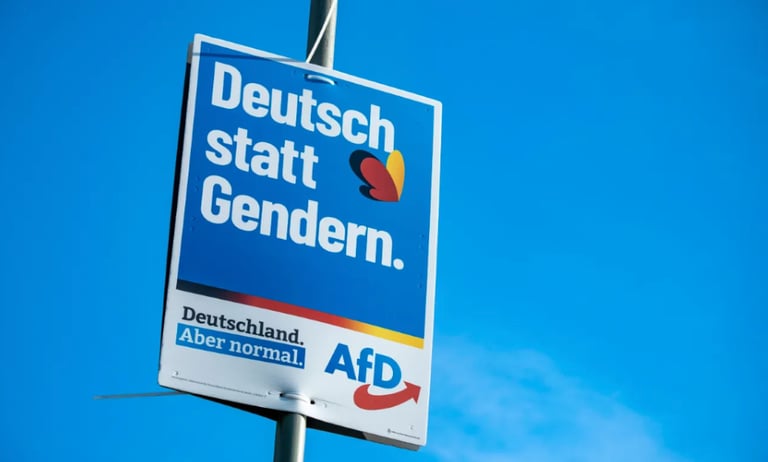
While the debate initially centred around the practicalities and technical linguistics of such practices, it was quickly captured by the German far right, which managed to frame the practice of Gendern in its own terms, namely as elitist and unnatural indoctrination. Eventually Gendern was tied to much larger issues around Gender, with actors such as the AfD foreseeing the destruction of the traditional family and the downfall of (Christian) Europe.
Nowadays, the largest centre-right party, the CDU (Christian Democratic Union), and especially the CSU (its Bavarian sister party), have adopted similar rhetoric and are actively fighting "gender language."
To be clear, there is a constructive critique of Gendern's practice (Simon and Faigle). This debate has a plurality of societal and linguistic aspects that would be outside the scope of this article. It is therefore not about whether Gendern is useful or not. Instead, it aims to trace how the far-right in Germany has been able to successfully instrumentalise gender-inclusive language and dominate societal discourse, which resulted in the adaptation of their agenda by the largest German moderate-right party, the CDU.
Gender-Mainstreaming and the practice of gender in the German language
To understand how this debate emerged in the first place, we have to look at the debated concepts and at the rarities of the German language.
1) Definition of Gender
The term "gender" refers to the idea that, besides biological sex, a person also adapts to a certain gender, which is shaped by society and constituted by our social interactions. One's gender is seen as distinct from a person's biological sex. This idea was developed by US feminists who sought to advance the debate on the innate and acquired traits of sex and gender, which are influenced by enduring patriarchal structures (Klein).
2) Gender Mainstreaming
Gender Mainstreaming entails the constitutional duty to enforce equality between men and women. According to the European Council in 2001, Gender mainstreaming consists of the reorganisation and improvement of decision-making processes with the goal that all actors involved in political shaping adopt the perspective of equality between women and men in all areas and at all levels.
The idea has its roots in the UN World Conference on Women in 1995. Since then, the German government has shown stark commitment to its implementation. One component of that entails making the German language more equal by counteracting the German language's male bias.
3) The German language's male bias
Since the feminist movement in the 1960s, the German language has been criticized by feminist linguists for being sexist.
German employs the Generic masculine, meaning that when referring to e.g. students of both sexes, one only says 'die Studenten', while also referring to the female students amongst the group (Duden). Feminists criticise this form because, strictly speaking, it only includes male students. The female plural of student would be die Studentinnen.
They argue that as language shapes our thinking, we will only think of male students.
This may not appear problematic at first, but feminist advocates argue that such language use contributes to the exclusion of women in everyday speech. For instance, the use of generic masculine terms often conjures up images of only male professors, doctors, or lawyers. A young girl who grows up hearing language that implicitly refers only to men in these professions may never picture herself in those roles. As a result, these fields remain male-dominated. Therefore, feminist scholars suggest that society can only overcome patriarchal structures and male-biased thinking when we free our language from these biases.
How we debias the German language, however, is subject to much larger discussions without uniform solutions. Ranging from naming both forms of a noun, e.g., 'die Studenten und Studentinnen', to employing neutral forms ('die Studierenden') to inserting special symbols like a / or a '*' into the middle of the word to indicate a spoken pause ('die Student/innen', 'die Student*innen').
The last form especially, containing the * symbol has sparked much controversy amongst linguists and the broader public (Scholl). While some linguists, for example, warn against retrospectively rewriting historical and non-gendered texts in gender-inclusive language, thereby altering their original context, others advocate the use of the generic feminine as a counterbalance to the use of the generic masculine. Notably, this debate is centered around linguistic nuances and practical feasibility and remains on the academic and administrative level.
However this initial technological debate was soon captured by the German Right. I argue that the German Radical Right was able to tie the topic of Gendern to a much broader issue regarding Gender. This continues to strengthen their argument and position regarding their negative notion of so-called Genderwahn (Gendermadness).
They managed to portray it as an elitist project against the will of the people and essentially mobilised large parts of the population against it.
This resulted in the shift of the Overton Window (what is considered to be sayable), with moderate right politicians adapting both the rhetoric and words and especially the policies of the Radical Right and making narratives of elitist conspiracies that aim to indoctrinate `the people' open to broad society.
A Timeline of Events
The beginnings of gender-language and its first opponents
Anti-gender campaigns can be considered a mirror to the transnational feminist movement (the second wave of feminism) that emerged in several countries in the 1960s.
By the start of the 20th century, women, especially emancipated and working women, ironically preferred to be referred to by the masculine form instead of the feminine one, e.g., being called 'Student' instead of 'Studentin' (the correct feminine form), as the feminine form was seen as inferior to the male one.
This changed with the feminist movements after the Second World War. First ideas of gendered language were employed. This development reached German universities in the 70s, and in the 90s queer people used the * sign for the first time (Gropengiesser).
The first, and one of the most prominent, anti-gender acts was the Vatican's protest against resolutions passed at the 4th UN World Conference on Women in 1995. The Catholic Church at that time did not accept the challenging of the, in its view, natural and God-given gender roles. The first framings of gender as a cosmopolitan and rootless project were spread by an elite group, specifically the UN. The backlash in this context was primarily driven by religious beliefs.
In the 90s, the first German federal states and public authorities began the adoption of gender-fair language. At that time the issue was bound to the universities and the public sector and not yet a politicum.
In 2004, der Rat für Deutsche Rechtschreibung, the Council for German Orthography began issuing guidelines on gender-inclusive language, notably without any mandatory implications.
The capturing by the right
The turning point and entrance of the radical right in Germany can be traced to 2006, when a newspaper published an article about Gender. Several right-wing media platforms, like Junge Freiheit (Young Liberty), started to publish articles and warned against gender mainstreaming and the creation of a new type of human. Soon the term `Genderism´, referring to Gender as an ideology and doctrine, was spread to the German audience, who at that time were not familiar with the concept of Gender (Lang). These right-wing actors were the entrepreneurs of those terms, coining their meanings for the broader public and giving them their first negative connotations.
The large-scale proliferation of the right´s notion of Gender can be traced back to the rise of the AfD, PEGIDA/Patriotic Europeans against the Islamization of the West and several other right wing movements during the `Migration-Crisis´ in 2015. Already before their rise into the party mainstream, the AfD criticized Gender Mainstreaming and included anti-gender rhetoric in its party programme in 2014. The right-wing newspaper Compact Magazin was one of the first to recoin the meaning of Gender Mainstreaming and imply an ideological and elitist agenda behind the term, mobilising the allegedly unpolitical movement Besorge Eltern/Concerned Parents against an assumed early sexualisation of children due to sex education that includes LGBTQ sexualities inside German schools. Inside the PEGIDA movement, Gender Mainstreaming was deformed to ideological Genderismus and even constructed as one of the main enemy figures of Christian Europe (Belltower News). These movements then rose to popularity during the 2015 “refugee wave” and spread their narratives even further.
But it was the European rise of the populist right that made cooperation possible. Social media and online petition platforms were established, which soon enabled the movement to become transnational, spreading both on the internet and through demonstrations.
Equally important was the interplay between Christian conservatives with the radical right. Ranging from unwanted hijacking of catholic gatherings as we had seen in 2008 by NPD (National Democratic Party of Germany) activists, to willing cooperations, for instance between German ultraconservatives and known political actors such as Viktor Orban (Strube). Even incumbent politicians, who ought to aim to represent their nations' interests were key figures in proliferating/operating transnational anti-gender networks.
The adaptation by the CDU
The AfD has seen unprecedented success, nowadays often being the most popular party in polls. Simultaneously, the political climate in Germany has changed. After the break of the liberal-green-social-democrat coalition, the SPD (social democrats) has taken office under a CDU (Christian Democratic Union) chancellor. Today´s government sees itself as the last chance for democracy and the CDU is currently plagued by the question of how to get back the electorate lost to the AfD.
In an attempt to win back their voters, the CDU has started to adopt the language and rethorics by the radical-right. Going back to the 2016 CDU manifesto, where the CDU advocates `against gender-ideology´ to the current party programme, where the party stated that `we are against gender-cohesion´ (CDU).
In 2021, the CDU led states of Saxony and Schleswig-Holstein prohibited the practice of Gendern in their public sectors. Since 2024 students in Bavaria, examined by installed recorders in classrooms, can risk getting worse grades if they gender (Kuzmany).
Most notably however is the break of the Brandmauer/the firewall, an informal agreement among the democratic parties of Germany to never collaborate with the AfD, in the state of Thuringa. AfD and CDU collectively decided on the Anti-Gender-Pakt in 2022. The practice of Gendern must be so grave for the CDU, that the Brandmauer had to be disregarded by the party. More and more often, the CDU employs language what reminds of AfD rethorics, let it be Chancellor Merz stating that `with every gendered news show, a hundred more votes go to the AfD´ (Maxwill and Mingels) or Bavaria's minister Söder (CSU) advocating against `gender-cohesion´(Hoffmann).
In that regard, the radical right has succeeded. They first coined the term Gender in wider discourse, transferring it into Genderism and making it out to be representative of elitist ideology. They were then able to give Gender and the practice of Gendern a different meaning by indicating that the German language will now undergo huge constraints and restrictions that constitute a larger picture of indoctrination of children in schools, resulting in the attack on the traditional family and Europe.
The Strategies and Aims of the Right
'We are in the middle of a culture war,' says Paula Braslawasky, Professor of Sociology at the Ludwig Maximilian University of Munich (Gropengiesser). Both globally and in Germany, the debate around gendern has erupted in large-scale polarisation. 'Gender is now at the heart of political realignment' (Graff).
Similarly, Dan states that `when identities are seen as being under attack, a psychological state of totalism ensues, leading to the rigid emphasis of differences and the diminution of perceived similarities´ (1). The debate nowadays is so polarised that a neutral discourse does not seem to be possible anymore. One reason is that it has been tied to all those overarching and identity-related concepts.
Since the UN Beijing Declaration and Platform for Action in 1995 and the first feminist scholars employing the term Gender and the goals of Gender Mainstreaming, the Right suspects a targeted ideology (Genderism) that is aimed at undermining plurality and democracy (in the sense of what right-wing ideology understands by that). The biggest hysterics warn of an EU-elistist agenda that aims to `completely exchange men and women´ (Strube 106). Some even frame Gender and queer people as paedophiles, demanding harder punishments for paedophile-related crimes and hoping to get greater access into society with such demands. The term Gender now serves as an overarching This term represents an indefinite category that encompasses multiple fears, such as the loss of national identity and the erosion of traditional family values.
The Right is able to target and connect various groups, ranging from the mentioned catholic church, where some parts oppose the notion of gender as an alternative to a God-given order, various radical groups and lastly CDU politicians.
Ironically, they mirror the tactics of the feminist movement, like building transnational networks and knowing how to redefine terms and words. With that, they are able to narrate the discourse.
All of this is made possible as the Right was able to capture the sensitive and controversial topic of gendern and give it new meaning. They were able to access a much larger group of the German population. Their racist rhetoric is more widely resented, surely no one wants to be called a xenophobe, but protest against the madness of all those extra signs, like the gender star * in the middle of words, is justified. The practice of Gendern is tedious and impractical, it only makes sense that people initially dislike it.
Furthermore, as the Right were the first to (re)define the terms, 'Gendern' and 'Gender' received a bad connotation, and suddenly gender-fair language became not only impractical but also the project of part of the elite class. The Right is therefore able to prevent an objective debate in the larger public and, furthermore, gain access to the middle of society. By using their words, which are now also adopted by CDU politicians, they effectively changed the Overton window within German society, shifting the normative boundaries of what is considered acceptable to say.
Opinion
We have to recognise when words and narratives come from the Right. This is easier said than done, especially when the Overton window has already been shifted. It requires both contextual knowledge and critical thinking, for which not everyone has the time and resources. In my opinion, this is where academia, media, and parties come in. We need to make the debate culture more comprehensible, accessible, and pluralistic.
We have to reclaim the debate, and with that, I don't mean to merely argue in favour of Gendern but instead to bring back the debate to objective and scientific grounds. This may arouse challenges, as it concerns peoples' identities. But that is exactly why we need to calm down and objectify the debate. This starts at the individual level and how we discuss and argue. But furthermore, as opinion makers, the democratic parties have to stop adapting the rhetoric of the Right. Especially the CDU, with its historically state-supporting role and internationally connected status, should not fall for the AfD’s plotting.
Germany might need conservative and (moderate) right politics, but those politics should not be a cheap copy of the AfD's programme. People will tend to vote for the original either way (Delhaes).
Instead, the CDU should return to issuing their own ideas that are hopefully not based on xenophobic and racist grounds. Their resentment for gendered language can be legitimate, but instead of acting as the AfD's parrot, they should become more innovative and employ their arguments. This would reopen the discourse at the broad societal level and prevent it from turning either into a merely inaccessible academic discourse or polarised pub talk that provides testing grounds for right-wing ideologists.
Works Cited
“Culture War.” Populism Studies: Vocabulary, European Centre for Populism Studies, www.populismstudies.org/Vocabulary/culture-war/. Accessed 14 Jan. 2026.
Christlich-Demokratische Union Deutschlands. Grundsatzprogramm der CDU Deutschlands. CDU, n.d., www.cdu.de/grundsatzprogramm/.
Dan, Peter. “Democracy under Siege: The Psychology of the New Populism.” Long Island University, 2 May 2019.
Delhaes, Daniel. “CDU sucht Anti-AfD-Strategie.” Handelsblatt, 16 Jan. 2025, www.handelsblatt.com.
“Die geschlechterübergreifende Verwendung maskuliner Formen.” Duden, www.duden.de. Accessed 14 Jan. 2026.
Graff, Agnieszka. Anti-Gender Politics in the Populist Moment. Routledge, 2022.
Gropengiesser, Dilan, et al. “Gendergerechte Sprache: Warum das Gendern so polarisiert.” Die Zeit, 4 Apr. 2024, www.zeit.de.
Hoffmann, Paul. “Grenzt Menschen aus: Markus Söder lehnt ‘Gender-Zwang’ ab.” Berliner Zeitung, 16 Jan. 2025, www.berliner-zeitung.de.
Kirschner, Ursula. “Gendern und Verbrennerverbot: Hubert Aiwanger beim Volksfest in Dietfurt.” Donaukurier, 27 July 2025, www.donaukurier.de.
Klein, Jeja. “‘Gendern’ ist ein rechter Kampfbegriff.” nd-aktuell, 10 Sept. 2021, www.nd-aktuell.de.
“Kulturstaatsminister verbietet seinen Mitarbeitern Gendersprache.” Die Zeit, 3 Aug. 2025, www.zeit.de.
Kuzmany, Stefan. “Null Toleranz.” Der Spiegel, 8 Dec. 2023, www.spiegel.de.
Lang, Juliane. “‘Gender’ und ‘Genderwahn’: Neue Feindbilder der extremen Rechten.” Bundeszentrale für politische Bildung, 20 Nov. 2017, www.bpb.de.
Maxwill, Peter, and Guido Mingels. “Streit über Sprache: Hat es sich bald ausgegendert?” Der Spiegel, 28 June 2024, www.spiegel.de.
Neuman, Scott. “Pentagon Plans to Begin Removing Trans Service Members from the Military Next Month.” NPR, 1 Mar. 2025, www.npr.org.
Pantel, Nadia. “Zwei Punkte zu viel: Wie Frankreich mit dem Gendern umgeht.” Süddeutsche Zeitung, 18 June 2021, www.sueddeutsche.de.
“Pegida und Gender: Von der ‘Homolobby’, ‘Umvolkung’ und ‘Gendertanten’.” Belltower.News, 21 June 2017, www.belltower.news.
Simon, Jana, and Philip Faigle. “Gendern ist reaktionär.” Die Zeit, 25 Nov. 2021, www.zeit.de.
Strube, Sonja. “Rechtspopulistische Strömungen und ihr Anti-Genderismus.” Universität Tübingen, n.d., bibliographie.uni-tuebingen.de.
“The Military: Hegseth’s Escalating Culture War.” The Week, 20 May 2025, www.theweek.com.
Wildleder, Yvonne, et al. “Warum die Genderdebatte so emotional verläuft.” Kurier, 18 June 2023,www.kurier.at.
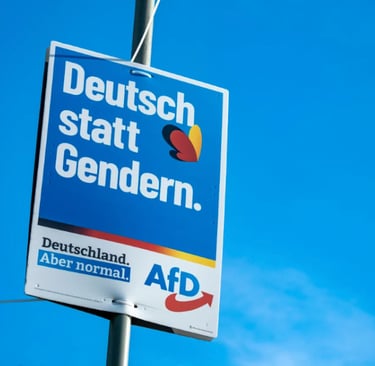
Translation: “German instead of Gendern.” underneath: “Germany. But normal.” (the AfD's current motto)From: Maxwill, Peter & Mingels, Guido. “Streit über Sprache: hat es sich bald ausgegendert?”, SPIEGEL, 28 Jun 2024, Streit über Sprache: Hat es sich bald ausgegendert? Über einen deutschen Kulturkampf - DER SPIEGEL