Harry Potter - An ANTIFA Manual 3/3
The Harry Potter series is a political allegory of resistance to fascism and injustice. The Ministry’s corruption mirrors real authoritarian regimes, while the Order and D.A. embody revolution. Through diverse, oppressed characters, Rowling links personal struggle to collective resistance. Drawing on European history and modern wars, she exposes prejudice and power abuse. Her message: equality and solidarity are the strongest magic against tyranny.
CREATIVE PIECES
Brody L.
11/16/20259 min read
Real-world allegory: From WW2 to Rowling’s Time
At the end of 1918, when World War I concluded in Germany’s defeat, many citizens protested with discontent, and nationalist fervour surged. Deutsche Arbeiterpartei (DAP) was founded. At its core lay the doctrine of Aryan blood’s nobility: anti-Semitism, anti-monarchy, anti-capitalism, anti-Marxism, and anti-democracy. It championed a socialist economy that would allocate wealth exclusively to Germany’s Aryan lineage. In its early years, the DAP numbered only a few extreme nationalists.
By 1920, seeking broader influence, the DAP renamed itself Nationalsozialistische Deutsche Arbeiterpartei (NSDAP), more famously the Nazi Party. Adolf Hitler, with his stirring oratory and hard-edged persona, was chosen chairman.
Anti-Semitism in Europe was already deeply rooted—fostered by religious and economic prejudices that had long cast Jews as outsiders. Yet Hitler’s contribution was unparalleled. He decried Jews as a subhuman threat to civilisation—a stain on Germany’s Aryan blood. He insisted they be catalogued, barred from intermarriage with Aryans—and eventually segregated, expelled from Germany, and, at his most extreme, utterly eradicated.
A key question persists: Did the genocidal programme evolve gradually into extremism, or did that ultimate aim lie within the dictatorship from the start, revealed in stages as he guided the populace until the moment was ripe? I believe the real atrocities of the Holocaust and the fictional suffering imagined by Rowling haverevealed something in one another.
The history of the wizarding world—and the two modern Dark Lords—echoes the Nazis’ rise. In ancient times, witches and wizards lived openly among Muggles.
Later, persecution and killings of wizards prompted the Ministry of Magic to enact the International Statute of Wizarding Secrecy to protect their own. Of course, any policy spurs both supporters and dissenters. Proponents argued secrecy ensured peace between the worlds; opponents demanded open war on Muggles to assert wizarding supremacy—and perhaps to rule them outright. After the Statute’s passage, open rebellion faded; dissenters feigned compliance even as, in private, they continued to despise Muggles and Muggle-borns, vowing blood-purity segregation. Such exclusionist sentiments lay dormant in wizarding society—always awaiting a voice and power to rise again and threaten the impure.
Gellert Grindelwald and Lord Voldemort both mirror Hitler’s “Kampf”. Grindelwald was the schoolboy troublemaker expelled from Durmstrang; Tom Riddle, upon graduation, had a meagre living at Borgin & Burkes. Each built a grassroot following through charisma and talent. Grindelwald believed wizards to be a superior race who should rule over Muggles; Riddle deemed Muggle-borns a subhuman scourge warranting extermination—reflecting the Nazi movement’s early and later ideological phases.
Voldemort withheld his full genocidal intent until later—just as Hitler did not unleash the Holocaust at once but escalated persecution until mass murder became state policy. Grindelwald constructed Nurmengard Castle for his opponents; in turn, when defeated, he was confined there. In real-world Nazi Germany, Nuremberg was both a military hub and site of concentration camps—and, after World War II, the venue for war-crimes trials.
Grindelwald’s signature originally symbolised the Deathly Hallows, representing his power and invincibility. Likewise, the swastika, before Hitler’s appropriation, was a sacred icon in various cultures; for him, it signified Aryan supremacy. In 1945, Grindelwald fell to Dumbledore; that same year, Hitler—cornered in Berlin—took his own life rather than face peace or surrender. Extremism and militarism had so shattered his popular base that Germany teetered on ruin, yet Hitler, maddened by hubris, drove himself to destruction.
This mirrors Voldemort’s end: abandoned by his followers, he hurled Avada Kedavra at Harry in a final, irrational act—an echo of suicide rather than conquest.
Rowling’s choice to retell the Nazi story as a fairy-tale fantasy series is intentional. Today, we view Nazism as an ancient atrocity—something unfathomable, the work of a once-in-a-century psychopath. Yet the preconditions for its rise—rampant antisemitism, ethnic scapegoating, and class-based contempt—have always existed. Hitler stirred those existing currents with little effort. His regime advanced step by step because the soil was already fertile. In every age, exclusionary nationalism, minority prejudice, and hierarchical disdain persist. The real sickness of Nazi Germany lives on in every corner of the world, and Hitler merely brought it into the open and made it a political project. When Grindelwald fell and the Dark Magic factions collapsed, Voldemort picked up the mantle of terror, reigniting hatred of Muggle-borns. This reflects the generational transmission of bigotry: give such people a leader, and the cycle repeats. The root problem is not Tom Riddle alone, but the mass base of hateful ideology he represents. The world still harbours prejudice seventy years after Hitler's death.
Nazi extremism targeted far more groups than just the Jewish community. Under Aktion T4, the regime executed the physically disabled, the mentally ill, and anyone deemed a genetic burden in the name of racial purity. Many had forced sterilisation to prevent tainted bloodlines from spreading. In the Holocaust itself, beyond Jews, the Romani and Slavs were slated for murder; while not slated for outright extermination, Black people, homosexuals, and political dissidents were stripped of basic rights and subjected to brutal discrimination.
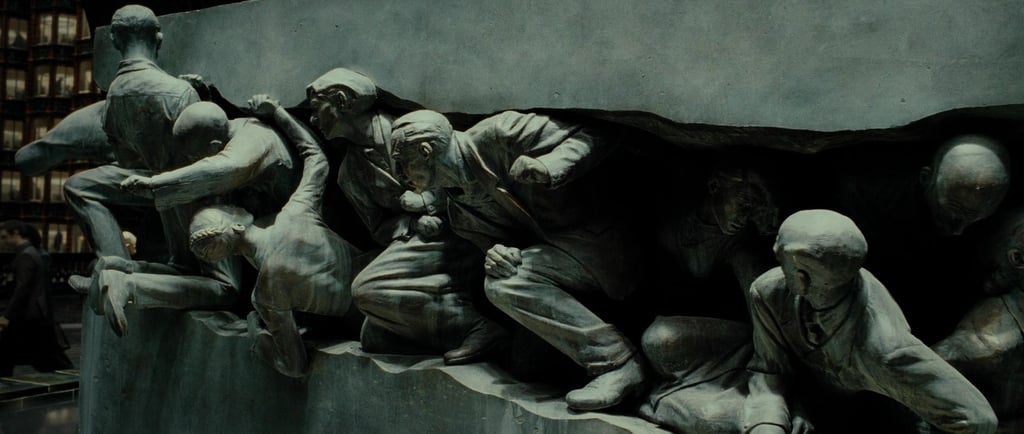
The wizarding world mirrors this. Under Voldemort’s reign, Muggles are seen as unworthy sub-humans; Muggle-born wizards must be segregated, and intermarriage is a treasonous crime. Yet anyone without pure wizarding blood suffers disdain and injustice. During Voldemort’s rule, the statues in the Ministry foyer showed wizards seated atop Muggle corpses—where once stood centaurs, goblins, and house-elves
looking up in reverence. Wizards extend their contempt beyond Muggles to other magical beings.
Take the goblins: they should stand as equals to wizards, yet are denied wand use, their property rights ignored, and are routinely talked down to. This has sparked repeated Goblin Rebellions. When Voldemort tried to seize control of Gringotts,
many goblins refused to bow and simply quit. They embody the dignity of the oppressed, standing firm and fighting for their rights.
Centaurs, too, should occupy a place of mutual respect with humans, but wizards—naïvely or arrogantly—treat them as beasts, disdainful of their culture and gifts. Social segregation generally maintains peace, but when it is violated, centaurs erupt in fierce resistance, symbolising those who avoid conflict yet jealously guard their boundaries.
House-elves are the sole high-intelligence species willing to kneel as slaves. Wizards grow ever more insolent, losing even the most basic respect. Though elves submit, they harbour resentment, exploiting every loophole to rebel in their own subtle ways—symbolising those who, resigned to oppression, find small outlets for defiance.
Giants and werewolves, marginalised and persecuted, have waged a war against wizards, ultimately abandoning mainstream society to live as outlaws and attacking any wizard they encounter. The narrative recounts half-giants and werewolves who endure shame and discrimination, ashamed of their identities yet powerless to change their fate. They represent those among the oppressed who camouflage their true selves and make fraught choices under duress.
All of this might seem clear—if only anyone attended History of Magic lectures. In other words, ever since they hired Professor Binns, no one but Hermione has a clue. Behind rivers of blood lie human folly and arrogance: we repeat the same mistakes.
We inherit baseless prejudices across generations, and countless lives are lost due to our narrow-mindedness.
So here’s the question: how do we define evil? At Harry Potter’s outset, the Big Bad is a homicidal maniac who slaughters wizards indiscriminately—even infants don’t escape. Of course, barely anyone at the age of eleven had a grasp of such horrors. Rowling never dumps every setting detail in our laps all at once; instead, book by book, she unveils wizarding prejudice against Muggles, against werewolves, and against giants; the enslavement of house-elves; misunderstanding of centaurs; disdain for goblins, and the intolerance of dissent. We’re inclined to see villains as born evildoers —but evil is never so simple. It has roots and motivations. Voldemort isn’t a crazed baby-killer for the sheer thrill; his followers are no blind lunatics. He famously declares, as he refused to kill pure-blooded Neville, “Every drop of magical blood spilt is a loss and a waste,” yet in his eyes, blood eclipses personhood. And that is how evil begins: as prejudice.
Prejudice, of course, is not the sole property of Voldemort and his Death Eaters. It permeates every corner of the wizarding world in varying degrees. Such people lack a fierce opposition to class-and-blood ideology. Even when the Dark Lord grows up before their eyes—and even quizzes them on Horcrux creation—they’re shocked afterwards that so brilliant a wizard could become such a monster. Where do we draw the line?
This prejudice thrives inside the Ministry itself. Many Ministry employees—if not Death Eaters—harbour their own biases against Muggles or magical creatures; even individuals who refuse to broadcast propaganda are controlled by corrupt superiors and influenced by Death Eaters. Even when they know the truth, they cling to office by tolerating incompetence or tyranny. Voldemort’s rise would have been impossible without precisely that complicit bureaucracy.
In 1937, as Nazi power expanded, Neville Chamberlain became Prime Minister of Britain, still recovering from World War I. The economy limped, armaments were scant, and war-weariness ran deep. Distrust of France even allowed Germany to grow unchecked. Chamberlain repeatedly ignored Hitler’s ambitions, chasing peace with delusions that Nazi Germany was a peaceful nation. His concessions emboldened the Nazis, rather than securing peace, and his failure to bolster Britain’s defences after the Munich Pact paved the way for even greater disaster. Meanwhile, state‐influenced British media lauded every Chamberlain speech and decision—“Long live our King!” —with no critique, duping the public to cement his rule. In some respects, Chamberlain and Hitler share a maxim: “Make the lie big, make it simple, keep saying it, and eventually they will believe it.” Chamberlain believed Winston Churchill’s criticisms were mere power grabs, so to preserve his administration’s image, he ignored his duty to defend the realm.
This is the template for Cornelius Fudge’s tenure: paranoid that Dumbledore sought to usurp him, he denied Voldemort’s return, manipulated the press to burnish his reputation, and failed to confront the Dark Lord in time—harming the very people he
swore to protect. Chamberlain did finally declare war, only to leave power to Churchill soon afterwards.
Thus Rowling spares no one in mocking the Fudge Administration—wilfully stubborn, manipulating the press, deaf to the people’s voice, elevating personal power and image above all, branding every critic a reactionary—doesn’t it all feel eerily familiar?
When Fudge fell, Rufus Scrimgeour took over as Minister. A better man, but no better leader. He refused to duck problems—and yet refused to solve them. Desperate for headlines and acclaim, he jailed a nobody, Stan Shunpike, then bragged in the papers of “progress against the Dark Forces”. He knew the grim truth, yet repeatedly and shamelessly sought endorsements from Dumbledore and Harry to polish his image. In the end, he “died a hero”—yet no official announcement mourned him; Pius Thicknesse’s bulletin merely noted that Scrimgeour had stepped down. His fate is inseparable from his relentless political posturing.
The Half-Blood Prince was released in July 2005. Four years earlier, on September 11, 2001, America was struck by terror. That November, George W. Bush convened his advisors—not to debate whether to strike Iraq, but how to justify it. In 2002, the CIA and DIA declared that Iraq possessed biological weapons, and the Senate, having
Secretly assured by three-quarters of its members that Iraq posed a grave military threat, the Senate voted to authorise force. In February 2003, Colin Powell addressed the UN and insisted that Iraq posed a threat to American security, a claim that he would later admit was misleading. The United States and Britain demanded Iraq surrender its weapons; in January 2003, Tony Blair flew to the White House and agreed, come what may, to invade—even suggesting they could bait Saddam into shooting down an allied plane to manufacture a casus belli.
The UN baulked: the evidence was thin, the plan unsound, and the threat to world peace immense. Yet the Anglo-American alliance pressed on, and in March 2003, the Iraq War began. The world watched Saddam Hussein topple—but the aftermath proved a nightmare: ISIS rose from the chaos, and the Middle East descended into turmoil. This is the tale of politicians sacrificing innocent lives on the altar of ambition—a story mirrored by the Rufus Scrimgeour Ministry in the wizarding world. Scrimgeour devoted himself to projecting strength, yet achieved nothing; Voldemort, by contrast, fed on that very ineptitude to seize power.
Thus, Harry Potter does not simply end with Voldemort’s fall. Rowling deliberately recounts the aftermath: the Ministry is purged, Death Eaters are rounded up, and corrupt officials like Umbridge are sent to Azkaban. Notably, Azkaban later abandons Dementors for their inhumanity—an echo of Guantánamo Bay, where harsh conditions and human-rights abuses under the Bush Administration drew UN criticism until President Obama began its closure. But Deathly Hallows appeared in July 2007—after those real-world changes.
The new Minister of Magic is Kingsley Shacklebolt: a seasoned Auror and Order veteran who, during Voldemort’s reign, broadcast on a clandestine station that “It’s one short step from ‘Wizards first’ to ‘Purebloods first,’ and then to ‘Death Eaters.’ We’re all human, aren’t we? Every human life is worth the same, and worth saving.” By then, Tony Blair had also finally left office.
Hermione’s stance is even braver: “Every life is worth the same.” For years, wizards have ignored their obligations to higher magical beings—and reaped bitter fruit. The starkest example is the house-elves. Bound by unconditional servitude, they were never respected because wizards deemed respect unnecessary. Yet when Dobby risked everything for Harry Potter, they proved their loyalty in blood and sacrifice. Most elves, having endured a lifetime of contempt, know no rights and submit to every indignity—but that does not justify trampling upon them. Other magical folks have taken note: Griphook aided Harry at Gringotts partly out of gratitude for Dobby’s burial. When Hermione first founded S.P.E.W. (Society for the Promotion of Elfish Welfare), it sounded like a joke—yet she was right: every creature has basic rights and dignity, and a wizard’s unthinking disdain is both wrong and self-defeating.
In Limbo, Dumbledore said:
“That which Voldemort does not value, he takes no trouble to comprehend. Of house elves and children’s tales, of love, loyalty, and innocence, Voldemort knows and understands nothing. Nothing. That they all have a power beyond his own, a power beyond the reach of any magic, is a truth he has never grasped.”