Tutto Passa
The concept of time is so deeply ingrained into how our societies work that it has become the very base of human thought. Yet, observing natural cycles appears to reveal a different dimension of it. A tree doesn’t count seconds, and it does not need a clock. It just adapts intuitively to its environment – it simply exists.
OPINION PIECES
Emanuele Cauti
2/16/20264 min read
Everything passes. Everything fades. Everything flows. Everything changes. It is hard to translate the Italian saying correctly, since it can be interpreted in numerous ways. The Neapolitan photographer Robbie McIntosh portrays the saying in one of his most famous photographs. It is tattooed on the chest of an old man peacefully sunbathing at the beach. The atmosphere of the image perfectly shows what TUTTO PASSA means. Sometimes it is used when something bad happens, as a reminder that it always gets better. However, read in a broader sense, it is comparable to the Latin phrase MEMENTO MORI. It is about the awareness that everything is temporary, and every second is only a tiny punctual unit in the eternal state of change that the world finds itself in. Nothing is perpetual. Everything is born, grows, and eventually falls apart.
This knowledge is inherent to the cycle of nature, which allows us to grasp it through observation. Photography is a tool that, given its special relation with time, can translate such processes into a visual language.
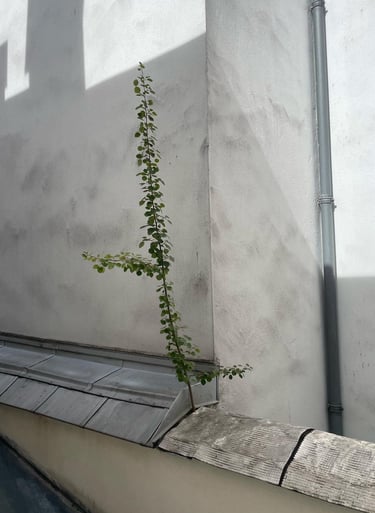
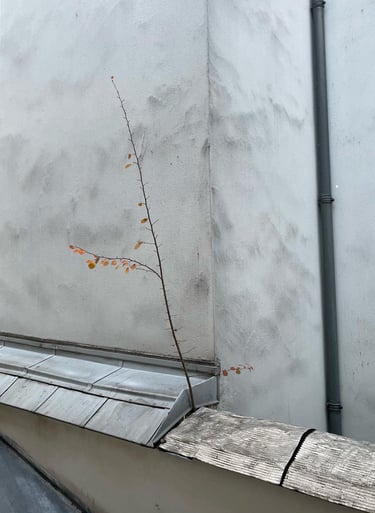
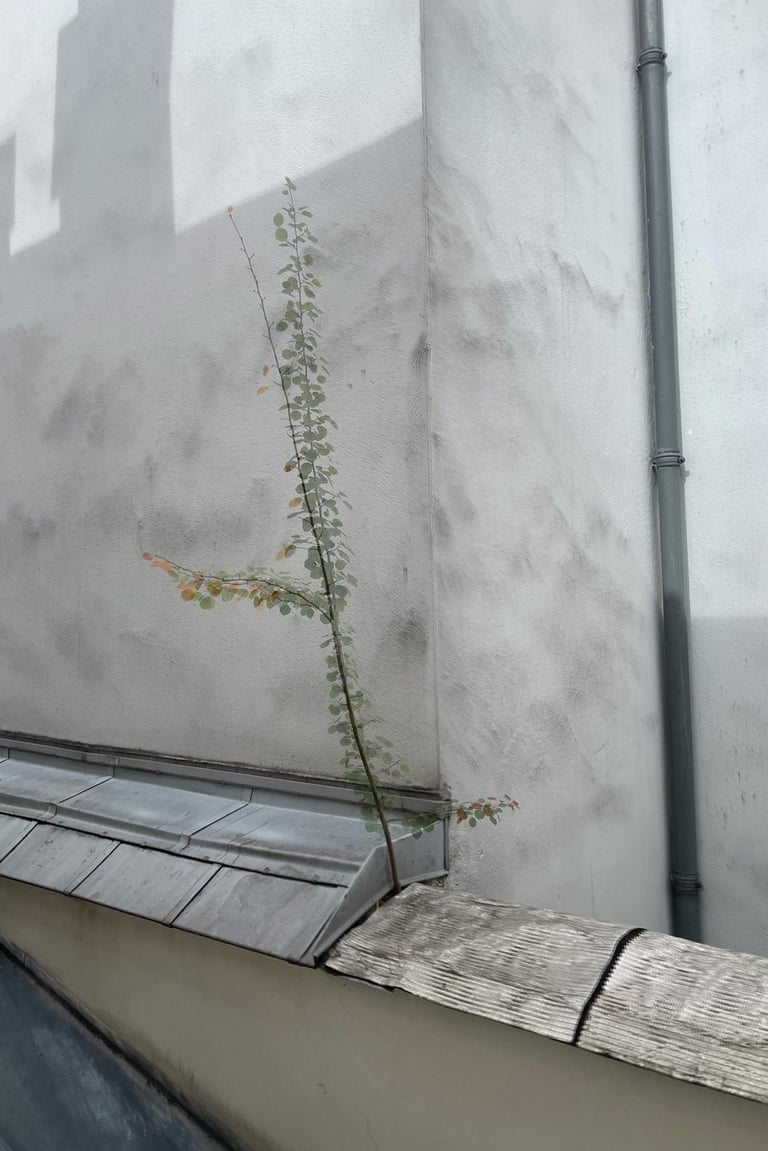
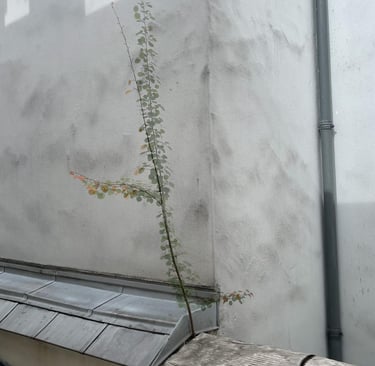
In the following photographic project, one tree was captured two months apart in the same location and in an identical frame and perspective. The only way to tell the photos apart is the visible impact of time on the environment: the sun's position, the shadows it casts, the tree's inclination, and the fallen leaves . We know time has passed because we see its traces. Yet, our eyes, as external spectators, are the only witnesses to determine that this is the case.
The tree, on the contrary, simply participates in the natural process of change, without regard for its past or future state.
The tree cannot count seconds, and it does not need a clock. It just exists, adapts when it gets cold, and thrives when it gets warm.
It is our human consciousness that, being able to hold memories of our past experiences, measures everything by a linear concept of time, even though most living organisms don't. An explicit awareness of the temporal dimension of the environment is not essential for survival. But it gives us humans a sense of safety and psychological orientation in our existential condition.
It is one of our unshakeable certainties that time is always and regularly moving forward without any room for unpredictability. It provides us with the feeling that we know where we’re going. Knowing when things begin and end makes us feel like we’re in control and can adapt in time if necessary.
In society, time helps us structure ourselves and increase the efficiency of our actions. The linearity of time helps us categorise the past and organize the future. We have begun to think of a human lifespan as a succession of static conditions, a timeline of consecutive stages defined by experiences and achievements. We might determine life phases by the city we live in, the work we do, or the partner we’re with. We see these phases as isolated units that succeed each other one by one. But by constructing our entire reality around this linear framework, do we risk narrowing our perception of what life truly is?
As the French philosopher Henri Bergson states in Time and Free Will (1889), “lived time” (durée) can rather be compared to a continuous flow, which cannot be measured linearly but is formed through the accumulation of experience. He clearly distinguishes between this subjective dimension of time and “clock time” (temps), which is objective and quantifiable. “Clock time” is the time of science, which can be subdivided into precise units and represents the very base of our intellectual understanding of the world. “Lived time”, by contrast, cannot be broken into equal parts, nor can it be studied objectively since it is inevitably tied to the consciousness experiencing it.
And what does this mean for the here and now? Bergson sees it as the result of a totality of things that have happened and shape the present moment, which is the only thing truly existing in what he calls “actuality”. Meanwhile, memories of the past and imaginations about the future exist in “virtuality”, which means they are projections of the human consciousness. Virtual factors that help design the present moment but do not actually exist in it. Therefore, our past life experiences and thoughts about the future are relevant, but only because they provide the matter out of which the present is formed.
The depth of the saying TUTTO PASSA lies not only in recognising the impermanence of things but even more in the call to focus on the present moment. Like the tree that doesn’t concentrate on anything other than existing and doing what it does. TUTTO PASSA is not a melancholic statement. The awareness that everything is ephemeral should not frighten us but rather comfort us by revealing that the present moment matters. Whatever its nature, it is important and deserves our attention. There is an intrinsic beauty to each passing moment, one that is fully revealed only when we allow ourselves to experience it rather than mentally dwell in the past or in the future. The popular saying is a reminder to internalize this knowledge and be present.