Ahoo Daryaei action
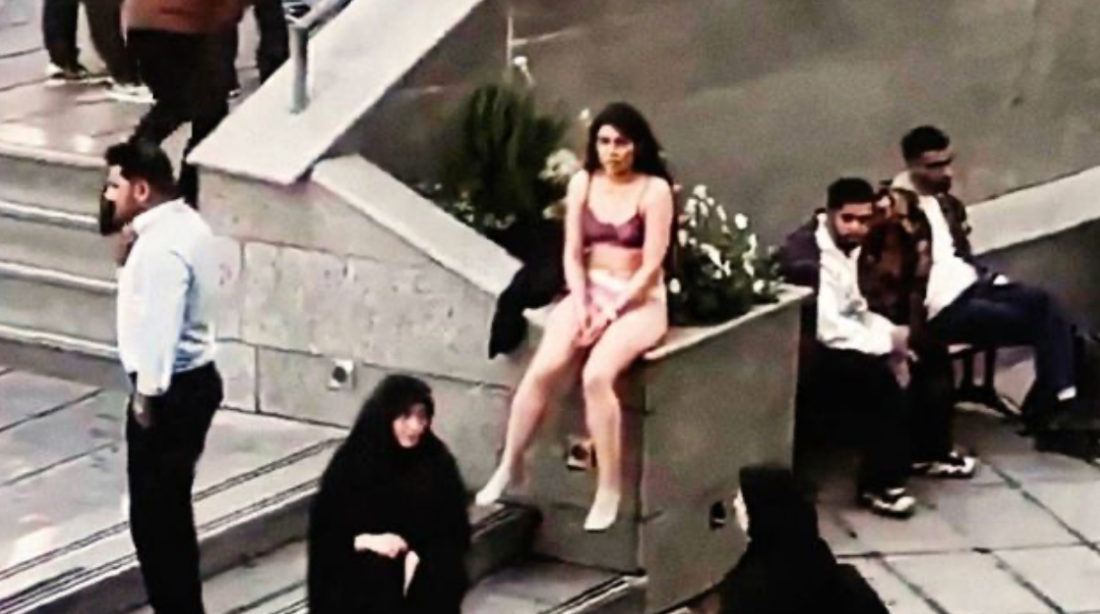
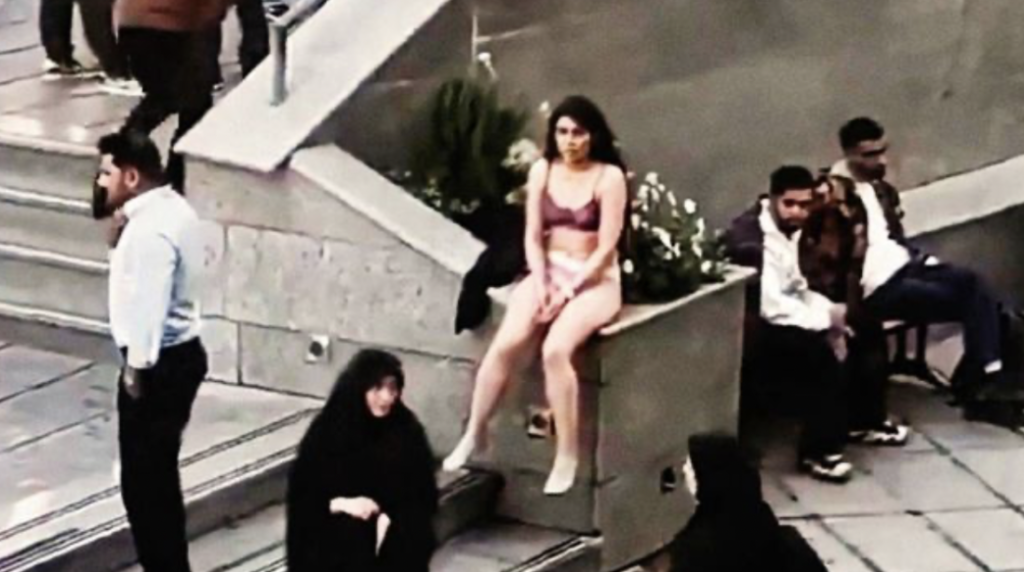
On November 2nd 2024, Ahoo Daryaei took her clothes off and walked through the streets of the Iranian capital. This act was filmed by a group of Iranian students, and a video of Ahoo Daryaei in her underwear in front of her university was posted on a protest group against Iranian politics, going viral around the world. In a second video posted later, she is being stopped, manhandled, and put in a car by the regime’s police. No one seems to pay attention to Ahoo’s nudity apart from the regime’s militiamen. During the recording, several girls are heard talking. One of them says, “Be careful, get behind the curtain to film”, revealing that filming these acts can also be considered an act of resistance. The absence of reaction of the civilians can be explained by the fear of repression of the population.
Political context
The Islamic Republic of Iran is an authoritarian regime relying on a strict application of the Sharia, an Islamic law with doctrinal, social, cultural and relational laws, since 1979. Freedom of expression, already under threat, was definitively suppressed following the 2022 “Freedom for Women’s Lives” demonstrations in protest against the sexual apartheid regime of the Islamic Republic of Iran (Amnesty International). The authorities cracked down on the protests, using illegitimate force and making numerous arrests.
The government considers women second-class citizens, including in marriage, divorce, child custody, employment, inheritance, and political office. The legal age for girls to marry is set at thirteen and may be even earlier if the father obtains judicial permission. The Iranian government requires women to wear a hijab, a veil covering the shoulders and head. If women refuse to wear it, they risk imprisonment, fines and restrictions on access to employment or educational opportunities (Amnesty International). In 2022, Jina Mahsa Amini, a 22-year-old Iranian-Kurdish woman, passed away due to physical violence experienced after she got arrested for “non-observation of Iran’s law regarding mandatory hijab” (OHCHR). According to a report from Amnesty International, Human Rights in Iran, “Thousands of people have been subjected to interrogation, arbitrary imprisonment, unfair trials and imprisonment for the peaceful exercise of their human rights” (Amnesty International). Enforced disappearances, torture, and other forms of mistreatment are widespread and systematic. Women, girls, LGBTQ+ individuals, and ethnic and religious minorities have been subjected to persistent discrimination and violence. Cruel and degrading punishments, including flogging, are regularly carried out. The use of capital punishment as a means of political repression has increased since 2022, accompanied by a surge in executions (Amnesty International).
In 2025, Iranian authorities escalated their crackdown on women’s rights defenders, such as singers, journalists, and activists fighting for equality. Women who defy compulsory veiling are subject to flogging, detention or even the death penalty (Amnesty International). “In the wake of the Woman Life Freedom uprising of 2022, the Iranian authorities consider the widespread defiance of women and girls demanding their rights as an existential threat to the political and security establishment. Instead of addressing systemic discrimination and violence against women and girls, they are attempting to crush Iran’s women’s rights movement” said Diana Eltahawy, Amnesty International’s Deputy Regional Director for the Middle East and North Africa Regional Office (Amnesty International).
Until today, we do not know the exact reasons why Ahoo Daryaei decided to risk her life by walking around barely covered. We only know that a short time before her actions, she was called off by the vice police because she was not wearing her hijab properly. Women are constantly judged on their clothing and behaviour by the Basij, a paramilitary force and morality police. We could imagine that her actions simply expressed despair from seeing her body totally controlled by government laws, which translated into a total rejection of vices and therefore could explain why she decided to undress (Chaillan). It could also be seen as courage and bravery, a deliberate act of insurrection in direct opposition to the authoritarian Iranian regime. Whatever its origin, Ahoo’s gesture is a political act of resistance against the regime and its repression of women’s rights.
The consequences of her actions
Aahoo Daryaei’s video has been generating various feminist marches around the world, empowering the movement “Woman, Life, Liberty”, originally a Kurdish political slogan used in the Iranian national movement. The protests in 2022, which followed the murder of Jina Mahsa Amini by the Mullahs’ police, embraced this theme. In Iran, Ahoo Daryaei became a symbol of resistance for many women. Plenty of tags are visible in the Iranian public space, such as «Ahoo Daryaei, woman’s body is waking up» or « where is Ahoo Daryaei?» (Alencontre). The NGO Hengaw Organization for Human Rights called for international action to release the young woman without charges (Connan). As a result, many protests took place worldwide. In Brussels, for example, several students mobilised in front of the Université Libre de Bruxelles and in London, activist groups organized solidarity demonstrations where some women stripped down to their underwear (Connan). Moreover, the name “Ahoo Daryaei” was mentioned in the media from all over the world. This international visibility allowed her to be released without any charges; however, the Iranian government considered her mentally unstable. (Connan).
Recently, women have been able to walk in the streets of Tehran while not covering their hair, without being arrested by the vice police (Ghazal Golshiri). Has the regime been losing its grip on individual freedoms? Well, not really. In fact, since Iran is currently the target of many countries such as the United States or Israel, the government wants to keep its internal affairs “peaceful” in order to avoid any pretext that could “justify“ military operations (Ghazal Golshiri). Therefore, to avoid any civil disobedience, Iran has decreased their repression on women who do not entirely dress according to the law. However, even if women can now walk more freely in the streets, political repression has never been so strong (Ghazal Golshiri).