Public opinion has long been a decisive force in U.S. foreign policy, yet it truly shapes outcomes only when it remains both morally attentive and analytically aware. Over the past three decades, the evolution of media technologies and political communication has refracted perceptions of war and peace across successive presidencies, from Bill Clinton’s televised interventions to Barack Obama’s invisible drone warfare. The result is a paradox: as wars have become more remote and less visible, civic vigilance has weakened, leaving democratic oversight fragile and selective.
When Visibility Turned into Vulnerability: The CNN Effect and the Road to 9/11.
When Bill Clinton entered office in 1993, his administration believed it could use limited military force to uphold humanitarian principles in crisis areas. That ideal was shattered in Somalia. The Battle of Mogadishu, fought on October 3–4, 1993, became a turning point, the horrific images of U.S. soldiers’ bodies being dragged through the streets, broadcasted endlessly on CNN, ignited public outrage and forced a rapid withdrawal (Patman 94). The incident, later dramatised as Black Hawk Down, marked the birth of the “Somalia Syndrome”: a deep reluctance to intervene in complex foreign crises (Patman 90-94). In response, the Clinton administration issued “Presidential Decision Directive 25” (PDD-25) on May 3, 1994, establishing three strict conditions for any future participation in UN peace operations: national interest, a clear command structure, and domestic support (PDD-25). These conditions effectively constrained U.S. engagement in later tragedies such as the Rwandan genocide and the Civil War in Yugoslavia in the beginning. Nevertheless, stepping back from direct intervention came with further costs. The vacuum created by the departure of U.S. and UN forces enabled Al-Shabaab and other Islamist factions in Somalia to entrench themselves, cultivating ties with Al-Qaeda that would later prove catastrophic. By the late 1990s, the consequences were clear. Terrorist attacks on U.S. embassies in Kenya and Tanzania (1998) and on the USS Cole in Yemen (2000) revealed the limits of a low-risk approach. Restraint did not equal safety. Instead, the perception of American disengagement emboldened transnational actors, setting the stage for the rupture of 9/11 (Patman 146-148).
The Theater of Truth: Iraq, Media, and the Collapse of Credibility.
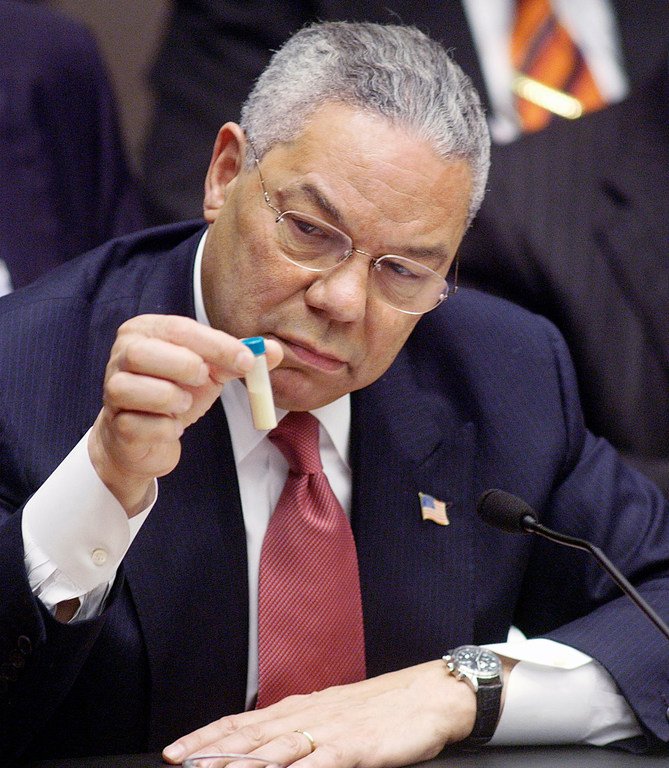
Unlike Clinton, the George W. Bush administration responded with the opposite reflex: over-exposure. The trauma of 9/11 fueled a willingness to act preemptively and to manipulate information in pursuit of legitimacy for the War on Terror. Specifically, on the 5th of February, 2003, Secretary of State Colin Powell addressed the United Nations, presenting satellite images, audio intercepts, and visual exhibits (Powell) intended to support claims about Iraqi weapons of mass destruction. The presentation, carefully staged for global television, became a defining example of how media spectacle could be used to justify war. What was once presented as incontrovertible proof of Iraq’s weapons of mass destruction was later discredited, eroding trust in institutions and exposing the malleability of truth in the digital age. Public backlash followed swiftly. On February 15th, 2003, coordinated anti-war demonstrations swept the globe (Verhulst 1-19), with millions marching in New York, San Francisco, Washington, D.C., and Chicago, as well as in Rome, London, and Madrid. Coalitions such as “United for Peace and Justice” (U.S.), “Stop the War” (U.K.), and “Tavola della Pace” (Italy) mobilised diverse constituencies: students, unions, faith groups, and activists. Their message was simple but profound: moral legitimacy cannot be manufactured. Despite the scale of dissent, the Iraq invasion went ahead, revealing a widening disconnect between public conscience and executive decision-making.
The Quiet Wars: Technology, Distance and the Erosion of Empathy.
By the time Barack Obama took office in 2009, the American public was exhausted. The wars in Afghanistan and Iraq had drained both morale and budgets, while the credibility of interventionism lay in ruins. Obama’s strategic innovation was not withdrawal but a transformation toward “light-footprint” operations, expanding drones and special forces to balance domestic aversion to casualties with counterterrorism imperatives. The 2011 killing of Osama bin Laden under “Operation Neptune Spear” (National September 11 Memorial & Museum) epitomised this model as a meticulously planned raid conducted with surgical precision and minimal exposure. Simultaneously, U.S. policy turned inward to secure critical supply chains for defense and technology; rare earth elements, vital for fifth-generation fighter jets and advanced electronics, became central to both military readiness and industrial policy (Humphries 7). The fusion of defense innovation and private‑sector technology blurred the boundaries between national security and economic competitiveness, while hybrid, remote operations reduced the human‑capital costs in terms of military personnel. But this technological sophistication came at a civic cost. The seeming precision and deniability of drone strikes distanced citizens from the moral and human consequences of conflict. The wars of the 2010s unfolded largely out of sight: clean on screen, messy on the ground. This ‘low-visibility warfare’ dulled public sensitivity, allowing operations to continue without the kind of scrutiny that characterised earlier eras. The same citizens once horrified by Mogadishu paid little sustained attention throughout the 2010s to reports of drone strikes in Yemen, the Sahel, Libya, Syria, Afghanistan, and Pakistan, and there were no widespread peace mobilisations in response (Pew Research Center).
The Return of Conscience: Gaza mobilisation and the moral awakening of the Western society.
The COVID-19 pandemic and its aftermath accelerated this drift: as societies grappled with internal crises, global awareness narrowed (Gaub and Boswinkel 5-6). These dynamics lowered constraints; as a result, some international actors moved to exploit emerging openings: Russia launched a full-scale invasion of Ukraine in 2022, in 2023, Israel mounted a large-scale ground invasion of Gaza in 2023 (Human Rights Watch 2025) and during the same period, China intensified pressure on Taiwan. At first, many Western audiences reacted emotionally but only episodically. Visual politics, the circulation of powerful images, flags, and hashtags, sparked outrage but rarely sustained it. The moral vigilance that once constrained policymakers became sporadic, a casualty of information saturation, polarised media ecosystems, and the strategic invisibility of remote warfare. However, the public conscience does not seem to be dead. Protests and mobilisation across the United States and Europe offer a thread of hope against the backdrop of recent developments in the Israel–Gaza conflict. In the United States, mass protests reignited the moral debate over Washington’s support for Israel. On July 5, 2025, thousands marched in San Francisco, Chicago, and New York. The wave of protests soon spread across Europe. Images of bombed neighborhoods, aid queues under fire (United Nations High Commissioner for Human Rights 14-17), and the obstruction of convoys such as the Global Sumud Flotilla (La Redazione) provoked widespread indignation and renewed empathy among Western publics. In major capitals, from Paris to Berlin, pro-Palestine marches drew unprecedented crowds, while in Italy large-scale strikes and spontaneous blockades from highways to airports in Bologna, Rome, Pisa, and Florence (Il Fatto Quotidiano) showed how collective conscience can still translate into direct civic action. This surge of public pressure had positive consequences; several European governments, including Spain, France (CNN), and the United Kingdom (BBC News), have recognised or moved toward recognising the State of Palestine, decisions shaped by both moral and practical opposition to Netanyahu’s conduct. As the protest wave gained international traction, combined with internal pressures, pushed the United States to step back. President Trump, initially aligned with Netanyahu’s agenda, gradually shifted toward a more conciliatory posture, ultimately reaching a negotiated peace deal between Israel and Hamas.
Conclusions.
That said, beyond political consequences, something deeper has emerged. The reawakening of public empathy across generations, after years of distraction and detachment, suggests that civic conscience remains a living force, capable of shaping history when moral clarity prevails. Although younger generations today face a wider range of insecurities and appear more anxious about the future of humanity, the collective shock that reverberated through public opinion, during the pro-Palestine mobilisations offers a reason for cautious optimism. It shows that empathy and moral awareness can still transcend polarisation and fear.
Carlo Consorte