ONE
It was my second week in the Netherlands. Everything was too new, too busy; there wasn’t time to sink into emotions that had already gone stale. Walking often in the night wind, the leaves hissing like restless paper, I felt cheerful, almost free, as if I had stepped out of a thick shadow. So, in those days, after three rounds of wine had painted my face red, I’d tell a new person I met this story.
I had a friend named Conard, born and raised in the south of England, in one of those towns where the rain never clocks out and the sun rarely bothers to show up.
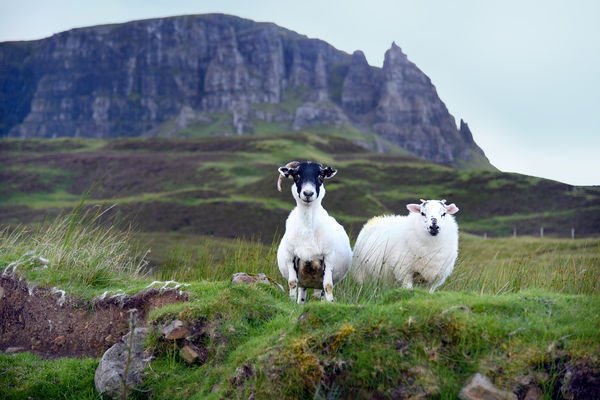
He grew up in a very traditional Christian household, though rarely went to church. He had his own way of getting close to God: from the age of twelve, he’d take the train alone all the way north to a desolate place called the Isle of Skye. He would sit on a cliff there, staring at the Atlantic for an entire day, then catch the island’s only bus, the last shift back. He kept at it for more than a decade—so much that the bus driver had changed a few times.
On those days, he believed his God was with him.
The Isle of Skye, “the place closest to the sky”, is a remote corner of Scotland. Inconvenient, hardly any residents. That round-island bus, on each of Conard’s pilgrimages, carried only him.
But the devoted Conard didn’t seem to win God’s kiss. In university, he fell into major depression. After years of therapy groups and medication that led nowhere, Conard decided to put an end to both his pain and his life. He thought the God he had believed in had abandoned him.
Unexpectedly, his father—himself a devout Christian—accepted his decision calmly, almost with composure. He only asked Conard to make one last pilgrimage to Skye. “If your God has abandoned you,” his father said, “then you should tell Him to His face.”
And before they parted, out of sorrow, he asked Conard, “if on that bus,” a bus that has been mostly empty for more than a decade, “should another soul ever board, then promise me you’ll live one more year.”
Conard agreed, but he didn’t take this futile request to heart. His purpose was only to say goodbye to the God he once believed in.
So, on his 25th birthday, he took the road again, like he had done for more than ten years.
Conard arrived at the Isle of Skye, sat at the edge of a cliff, and whispered to the Lord all day. He said farewell to the clouds, farewell to the Atlantic. Rain has to fall to the ground eventually, he thought.
Time to go back.
He waited at the bus stop, prepared for emptiness. He was almost eager for it—the familiar emptiness, like seeing the same scene from when he was twelve.
But what came next stunned him: the bus, built for thirty, was crammed with nearly fifty people—an aunt peeling a banana, friends shouting, couples taking selfies. Asian faces everywhere, glowing with laughter, filling the aisles and the seats, splashing against the windows with the sea behind them.
“In July 2017, a coach bus full of Chinese tourists broke down on the Isle of Skye. The police, after the guide called, told them to take the island’s only bus. So more than forty of them happily climbed onto a bus that for over a decade had been running empty.”
The July Atlantic was calm as always, as it had been for millennia. Conard thought he had witnessed a miracle. His Lord had not abandoned him.
The story should have ended there. But Walnut Tree interrupted, asking: how did you even know Conard?’
I was grateful for that. Walnut Tree was the first to look into my eyes and listen all the way through. “Because I was one of the travellers,” I said. “On the way back, I became his friend.” And so the story was complete.
Walnut Tree said, “My God, I believe that this is a true story. I’m delighted that you managed to board the bus. I’m glad I met you.”
In the many conversations that followed, Walnut Tree could always hear what I did not say. I told him, “I’m glad I met you too.”
But then he suddenly asked, sharp and casual: “So where did you get the money to go that far?”
TWO
At the time I had just moved to The Hague, studying environmental science, living in a student housing block that looked like a stack of orange shipping containers. It was out in the suburbs, surrounded by Middle Eastern immigrants, retired pensioners, and broke students. My room was about fourteen square metres for five hundred euros a month. In a place where a tram ride could easily cost over ten, that was considered cheap. I had a kitchen, a bathroom, and a single bed. The desk was jammed against the radiator; I kept stubbing my toes on it, then collapsing onto the bed clutching my arse and crying. The wardrobe stood by the entrance wall, the only chair in the room stood beside it. On the kitchen’s tiled wall there were grease stains, old ones, and the landlord half-joked, half-warned that I might have to answer for them.
I couldn’t bear to spend much on furniture, so for the first half-year, whenever friends came over, we sat on the floor or the bed. Some boys mistook that for an invitation. Later, someone said that even for a Japanese monk, the place would still need a low table. So I used my suitcase, threw a sunflower-print bedsheet left by the previous tenant over it, and suddenly the room looked more respectable.
“That’s true, look at this place…” When Walnut Tree asked me that question, I felt embarrassed.
He laughed, eyes locked on me: “It’s fine. I’m broke too.”
I met Walnut Tree at a friend’s party. Dozens of people crammed the living room, the kitchen, and the garden. After a few lines of small talk, everyone wanted to know where I was from and why I had come. At that time it was the question I dreaded most—the wrong question. Wrong questions don’t have good answers. When the Chinese get asked the wrong question, they don’t know what to say—they sneak away instead. In my years in Europe I’ve had that conversation countless times, and I’ve always been glad that from the beginning I refused to be a walking Chinese news channel.
I stood in the corner of the garden smoking two cigarettes, while three boys, each two heads taller than me, pissed not far away, when I remembered my friend had a Bluetooth speaker. I wanted, after all, to play a lovely song, some way of expressing myself. I searched until I found it in his hands. He was sitting in a single armchair in the corner, a warm floor lamp beside him, playing guitar into the speaker. That corner seemed to have its own magnetic field, shutting out the crowd, and I was drawn to it. I walked carefully over and sat down on a chair I found.
“Hey?”
“Hi.”
“Can I play something?”
“The guitar’s kind of out of tune,” he said without looking up.
He thought I wanted to take the guitar from him. “Well, do you know Imagine, that song?” “I can play, but I can’t sing. I’ll play, you sing,” he said, smiling now.
We finished the song. Nobody came over. Laughter floated in from the garden. I felt I had to say something, “let’s start a band!” He responded, “then we’ll need a decent guitar”.
What happened next was almost cliché. On October 12, he took me to a second-hand shop in Laak. We biked half an hour along the canal, under a perfectly clear October sky. We picked out a used guitar from the white-bearded shopkeeper—an obscure Japanese brand but in decent shape—and found new strings, twenty euros altogether. By the time we left the shop, it was dusk. His dorm was nearby, so we rode there to change the strings.
We used his bike tools to fix them; it took only minutes. When it was done, I sang a song, and he cried. He didn’t understand Chinese. I watched him play a few songs until it was very late, though it felt like ten seconds. The music stopped. Walnut Tree and I smoked on the balcony, a neighbour across the way lifted his glass at us.
Then he offered me vitamins. Vitamins. His apartment was sparse, almost empty: bottles of vitamins—three of vitamin D alone, a dusty MIDI keyboard, a dying plant, a sleeping bag, a tent. His clothes for all seasons barely made a pile, two with holes. One day we cleaned his place and found a Kerouac under the bed, with some signatures I couldn’t read. He said he’d barely made it through a few pages.
Walnut Tree and I lived on opposite ends of The Hague. An hour’s ride, fifty minutes if you ignored all the traffic lights at midnight, through canals, Chinatown, a patch of woods. By eleven every supermarket was shut, and I was too lazy to ride back. I asked if I could borrow his sleeping bag for the night. He thought for a while, then said, maybe the bed fits two.
So we lay there, thirty centimeters apart, having talked a little. Honestly, I wasn’t thinking about anything. What was he thinking? I don’t know. He fell asleep quickly, shallow snores, his head drifting onto my shoulder. I froze. In the morning he woke up, and I had a crick in my neck.
THREE
After that, Walnut Tree often biked an hour across the city to tutor me in high school chemistry. God really is unfair to an oriental—the same subject, once in English, suddenly made no sense at all. One evening it got late, so he bought a toothbrush and toothpaste from the Polish couple’s shop downstairs. I didn’t protest.
Later that toothbrush showed up in my cup, and I didn’t object then either. Eventually he simply stayed. He admitted the reason he stuck around was because his dorm had nothing, and the plant hardly needed water. That was probably true.
We rode our bikes together a lot, sometimes with tents, sometimes for a week at a time. When darkness fell, we pitched camp in some fields and moved on the next day. The countryside in the Low Countries was beautiful, the horizon flat as paper, never hiding a single cloud or sunset. There were hardly any people, sometimes none at all, only cows staring at us from behind fences. We’d eat lunch sitting on fallen logs, pasta sauce full of beans and chickpeas—because Walnut Tree was a vegetarian environmentalist who needed protein, and because beans were cheap. After lunch the belfry of a distant church stood sharp against the sky, and we’d ride another hour or two, cutting through farms, the smell of horse shit, the smell of cow shit, the road signs saying tot ziens on one side and welkom bij on the other, sudden stray cats darting out. He spoke of the warming climate, said that Dutch cattle farming wouldn’t last, that humanity wasn’t much good. He sounded bitter. I told him, from an evolutionary perspective, maybe humans were the cancer of the earth—but you’re a good person. He said, “thanks, you’re a good person too.”
Was I? 2020, for me, was a year in desperate need of good people. Maybe I was desperate for Walnut Tree. Did I need him because he was a handy white man or because he was good? But since the storming of the Bastille, has there ever been a year that didn’t desperately need good people? In the end, leaving good people alone is never a good idea.
That night the stars were thick. We sat by the lake behind his dorms, then on the steps outside, pouring our hearts out, sharing everything on our phones worth sharing. At last I tried to say I love you? I don’t even know. What came out in English was, I don’t know how much I love you. Which eventually sounded like, I don’t know—I might love you a lot, unbelievably a lot. In the end I didn’t know what I was saying anymore. Before I could get on my bike and flee, this good man replied, “I can’t promise you anything, but I’ll try.” The next day he scrubbed every tile in my kitchen until they shone.
FOUR
For half a year, Walnut Tree fixed many things with his bike wrench—except my bike. The bike had been left to me by a Korean girl I worked with; it was very small, with broken brakes. I nervously put one foot down to the road at every intersection to stop bike. I gave him a new wrench, but the bike still wasn’t fixed. His bike had no gears, and carrying me on the back was nearly impossible. I was annoyed, but the conclusion was clear: neither of our bikes was fit for long journeys anymore. We suspected that it was better to locate a place and live together. For the record, in the Netherlands, unmarried cohabitation is legal.
Before deciding to move in together, I dreamed about quitting my lease, pooling our savings, buying a secondhand camper, and travelling everywhere. I was excited, convinced this was the perfect shortcut to becoming Dutch. He liked the idea too. Then my passport reminded me: no registered address, no valid visa. Lightning strike. In Europe, without settlements, there could be no wandering. What a paradox. I cried on the spot. He tried to comfort me and said we could travel sometimes instead. I thought he was childish. He wasn’t Lennon, I wasn’t Yoko, this was the 21st century—I was me, du bist du. That was our distance: one passport. Love couldn’t fix it. Marriage might. But marriage could ruin love. Forget it all, let’s just rent a flat.
Housing in the Netherlands is a lottery, and luck was on our side: we found a place downtown. The second floor of what used to be a gallery, later storage space. High ceilings, forty square meters, floor heating. Impossible for one person to afford, but split between two it was cheaper than before. Only problem: between us we owned nothing but a guitar, even the forks belonged to the landlord. And even though we’d rented the cheapest flat in the city center—just over five hundred euros a month—one month’s rent was still equivalent to a Chinese middle school teacher’s entire salary. Weren’t we, like all living and dead things, on this planet entitled to a place in the world? That dignity should depend on money is absurd. Dignity shall be there because we are human, not because we labor. People invented money, invented the link between money and value, then fought wars and died for it, when all of us could simply agree one day to make it worthless.
So we begged friends for cast-offs. When they heard we were moving, they seemed more excited than us. The Italian friend showed off her flea-market vacuum cleaner: a bargain, she said, and gave it to us, wasn’t it perfect timing? She plugged it in and paraded it across the rug like a TV salesperson. See? Perfect. Can you believe it? Only 120. The Dutch friend said, take my desk, my father made it for me, but I’m moving into a basement, no space. The Spanish friend swore, coño, I applied for this apartment too, but the landlord hates single students—so please invite me to your housewarming! Fine, we needed furniture anyway. Otherwise our friends would come over and eat pasta with their hands sitting on the floor.
Finding a sofa was easy: we found its owner, who seemed not to know where it came from either. It lay in the dorm corridor like a hungover tramp, brown leather scuffed, seventy-five euros. The dining table was harder to find until finally we bought one from a British alumnus for fifty. Four chairs cost eighty, sold by a Muslim man: aluminium frames, thin wood painted with fake veneer, the kind from classrooms, reeking of smoke. We left them on the grass for a few days to air out.
Later we saw on WhatsApp that an American student dropping out was selling everything. He played football, British football, had come with money, bought all his furniture and appliances new from IKEA and Mediamarkt, and slept alone on a massive bed that would take up two-thirds of our bedroom—outrageous. The bed had cost over two thousand euros, with a Simmons topper on the spring mattress. We wanted it badly, but he asked a thousand. Too much. We told ourselves we could sleep in sleeping bags on the floor, stylish, like real hippies. But as his departure neared and nobody bought, he messaged us himself: six hundred, take everything.
How could we say no? We took the bed, plus a solid wooden shoe cabinet, a rolling shelf, three padded chairs, two extension cords, and few excellent iron pans. We nearly emptied his room and felt guilty enough to leave the dishes and lamps. That summer, Walnut Tree’s national football team played the Euros. We lay on the American’s bed watching live broadcasts. The team won, and we toasted the American in his absence.
FIVE
We moved in June. Walnut Tree’s mother drove two days to help, bringing tableware and tablecloths prepared by buni—his grandmother. A red Dacia 1310 sat on the grass in front of the shipping-container dorm. The cassette player stopped. She stepped out at two in the morning and pulled a bottle of anise liquor and three short glasses from the back seat. Walnut Tree said, ‘Mama, nu e bine asta.” Mama, this isn’t good. She said, Și ce dacă? So what? Cheers. The road was long, gas expensive.
His mother worked in Germany as a contracted carer and spoke almost no English, but the few words of German we each knew were enough for jokes—the joke being that we only knew a few words of German. She was an old hippie, listened to Celtic folk songs, and had drifted for decades between jobs. She asked if I knew Tai Chi. She fell asleep, wrapped in a blanket, to the smell of hand cream in the trunk mixed with cheap gasoline.
The next day we moved the American’s bed. It came apart into planks, too long for the Dacia’s trunk. Even with all the back seats folded down, there was still half a metre sticking out. We had to pick hours when the traffic police were asleep, like two or three in the morning. He drove, and I sat shotgun, watching for flashing lights and bedboards sliding out. But life isn’t a Hollywood film: the only person on the street was a drunk in a work uniform who stared at us vaguely for a while. No police cars, no sirens. We arrived safely and counted the pieces; not a single one was missing. We built the bed, and slept until morning.
The next day, everything was blurry. The window creaked; we had forgotten to close it. I curled in his arms and said, in my imagination this is how summer on the Isle of Skye would be, the quilt soft and warm like a summer cloud. He said, Mm. I said, you
know I’ve never actually been to Skye, right? He said, Mm. I said, the story was something I heard. He said, that’s why I told you: you will surely get on the bus.
What we ate at the house-warming, I forget. Nobody suspected the coffee table was really the American’s shoe rack. In the evening everyone went to Scheveningen beach. At ten it was still light. Coming back, Walnut Tree disappeared again, reappearing with a two-meter decorative painting salvaged from a junk pile and a traffic sign from a patch of grass. The sign read “no entry.” He scrawled “capitalism” across it. We taped posters on the wall, some pulled from cinema facades. To steal posters, you must move slowly—anyone moving too fast looks guilty. Posters on the street aren’t anyone’s property, not really, so maybe it wasn’t guilt. Or maybe that was just our excuse.
After the party, once everyone had gone, Walnut Tree pulled out a HEMA bag like a guilty man. I bought you something. I thought it would be lingerie or something equally suggestive, so I laughed and told him to open it himself. It was pajamas. Pajamas. In my memory I’d never owned a pair: I always wore the next day’s clothes or old thermals to bed. In a life of drifting, you keep everything minimal—three or four outfits per season. Pajamas were a luxury, and since they had to be washed, they couldn’t exist in odd numbers. Pajamas implied settlement. A home. A certainty in life.
And that was what gave this room its meaning. With me, the drifter, accepted here, we began to live a family life, as though that whole discussion about residence permits had never happened. We even tried making tofu. First, you need soy milk. We got a used a soy-milk maker from some internet acquaintance, free of course, using lemon juice as a coagulant. I bought cheesecloth from a hardware store, pressed the curd with every heavy object in the flat—pots, Sebald’s The Emigrants, and my Dutch B1 textbook. We spent an entire day making one bowl of lumpy tofu.
The next year, we worked shifts: he worked days, and I worked nights. He sorted and delivered packages; I did cashiering, sweeping vomit in a bar. We saw little of each other, but there was money. For my birthday, Walnut Tree took me to a jazz concert. Imagine us going to jazz! I wore a dress for once. Embarrassed, he bought a second-hand suit jacket along the way. The trousers and shoes didn’t match. Inside the bright hall everyone else was dressed to the teeth, old men in sharp suits and an old woman wearing a pearl necklace with each one larger than a bitterball. We looked more ragged than anyone. He whispered that I should pull my neckline lower, and we could count how many old men sneaked glances. We laughed silently. On the way home he said the Danish musician talked like he had a boiled potato in his mouth, and he mimicked it, and I laughed again.
That night it snowed unexpectedly. We passed under the bridge at the train station, the frozen steps slippery. I thought of Walnut Tree always going on about global warming. In a few decades, maybe there won’t be any ice, polar waterfalls, or grass growing everywhere, polar bears shedding their fur and turning into monkeys, the south rotting into swamps, or some people evolving gills. I hoped our faces would still have noses so we could wear masks, burning plastic waste for bonfires. We’d still have no money, but money would buy nothing anyway. Walnut Tree, I’ll give you a plant that doesn’t need watering. If the market economy collapses, can love still be called ‘priceless’?
SIX
At the end of 2020 we went for vaccines. The guy looked at Walnut Tree’s ID, then at mine, and said: you’re Chinese, he’s Russian? I was furious. His ID was an EU one. Since when did the EU include Russia? Did people see me and assume he must be Russian? Walnut Tree didn’t seem to care. He wasn’t Russian. His surname was Popovici.
He came from a former socialist country. One Christmas I spent at his grandmother’s. A block, three hours from the shipyard by the sea. Cane fields and corn on the roadside, farmers selling watermelons by the tracks. Buni’s flat had no laundry room, only a storage cellar filled with jars of her own pickled cucumbers (castraveți murați), peppers (gogoșar), and canned peaches (compot). After dinner we sat with her on the sofa outside the kitchen watching TV. Pop singers danced on a Christmas special. Walnut Tree glanced once, muttered: election season, the man who threatened to kill journalists will probably win. Then he lowered his head back into his book.
That spring, The Hague’s parks were nothing but mud. Ukraine had recalled its citizens to fight. Walnut Tree’s home was close to the border. We donated supplies. Between us we had two power banks, we gave away one. From an alum who was moving, we found a blanket and pillow, thinking maybe in the rubble warmth would matter. But who knew what it was really like? Could children even sleep there? After years of moving around, I’d already learned not to count hours during lost sleep. If you cancelled the 24-hour system and lived everywhere by moon time, insomnia wouldn’t exist.
In March, Walnut Tree hitchhiked to Spain to meet me. With his handful of Mongolian phrases, he travelled with truck drivers and probably scrounged lunches too. When he arrived, he pulled out a bottle of liquor he’d somehow gotten in Belgium. Clear, with gold flakes floating inside. Fake, I thought. Pear flavoring, like perfume. Two drinks in and I lost myself in memories on the sofa.
The first night, at a bar, we met a man in a fraying suit, shoulder seams split. He talked about Buddhism and elections and looked like someone straight out of Kerouac. But as the bar closed, we realised he hadn’t paid. Outside he staggered, picking cigarette butts off the street, his words sliding into nonsense, no longer even aimed at us.
We didn’t want to interrupt him but finally realized he might be homeless. We asked where he lived. He said he was English, had studied here, never wanted to go back, and pointed vaguely at some place nearby. Then he left and disappeared into the night. If he was telling the truth, in this job market—I don’t want to know what he studied.
Our Airbnb hosts in Spain were a couple. She lived on love, drifting, worshipping wisdom, with a simple, bright view of the world. He had a PhD in philosophy and worked in a hotel. He called himself a musician, a man barely one hundred sixty tall, speaking with the certainty of an emperor.
The spare room faced the courtyard. When he wasn’t at work, he sang opera inside. He had no talent; it was pitiful. Some nights they slept apart. His snores are heavy, hers are slow. I thought: this is what marriage sounds like.
Why was she so kind? I even fell for her somewhat. Maybe because she was so good she could tolerate a man like him. He talked about politics and philosophy and couldn’t stop lecturing on China’s policies. She usually just said one word to me: cansada. I’m tired. She was fifty, always smiling like a girl when she spoke to me. She worked ten hours a day. Her innocence evaporated the moment she punched in. Most of the time: cansada. Only cansada.
In Spanish, casada means married, cansada means tired. Casada, cansada. Seasons long, and tedious.
Before leaving Spain, he said if Spain had China’s technology, they could solve terrorism. I said, under Franco there was less terrorism, do you want to go back? Do you want to hand over your privacy so the police can watch your entire life with one click? He said, if it could bring back the Basque thousand dead, he would. He said, “China is clearly number one, what other country can build a skyscraper in seven days?” In agony I replied, “if you’re willing to work fourteen hours a day for less than twenty euros, even unpaid for years, maybe you can too”. He said, those are details.
Why are our details details, and your thousand dead not details? That rainy night I felt my heart break again. Later I thought I’d forgotten, but in unguarded moments the pain ripped through me again.
SEVEN
Looking back, it made sense why Dutch friends weren’t too fond of Walnut Tree at parties. I couldn’t tell if his vegetarianism was a cover for being broke, but he joked he was an eco-vegan—eco as in economical. If everyone was chipping in for food or
drinks, he stayed out. Some Europeans thought people from former socialist countries never shook off Soviet logic, and that explained his low income. Their compromise with him was the MIDI keyboard: he would play at parties, free entertainment, in exchange for drinks.
I could sympathise. My first Western European friends only came after I showed I knew something about Western aesthetics or Japanese photography; like that knowledge turned me from “a Chinese” into “a person”. In Sweden once, a British man looked disappointed when he learnt I wasn’t Japanese—so openly disappointed I wanted to comfort him in Japanese just to save his feelings. Chinese faces carry a kind of fatigue; European faces, a kind of innocence. Sometimes, I hated them for that innocence. Sometimes I thought: maybe we are measured differently, but both are trapped in systems just the same. Hard to weigh degrees of damage.
On the way back, Walnut Tree broke his own rule and agreed to fly. After landing, we tried hitchhiking outside the airport. At 9p.m., several cars stopped, but all were dropping friends off to return to Ukraine and fight. Our conversations turned into condolences, and we didn’t dare to ask for rides. Finally two Polish guys picked us up, shouting ‘kurva’ every few minutes; we had no idea what we talked about. Later another car stopped; a man blasting electronic music and raving about Berlin’s squatting movement, socialism, dropped us at our door and asked for 150 euros. Walnut Tree nearly fainted, thought hitchhiking was always free, but paid anyway.
Back home, he said he was being naïve. You didn’t need to split the ride, he said, stubbornly. People say hitchhiking is a privilege of white men, while Asian women are at greater risk. Was Walnut Tree’s so-called naïveté a violation of the rule, or was it simply another exception to privilege?
In 2022, we travelled from Slovakia to Belgium on Eurorail, switching trains. One evening we got off in a Swiss town. The tracks ran beside open fields, mountains close enough to touch. In the grass stood a wooden house hanging with wooden masks. No shops in sight, not a soul around. We strapped on headlamps and climbed for half an hour in the dark. We found the ruins of a castle, its walls built with a mediaeval lookout. We wrapped ourselves in raincoats and slept. Flies were thick all night, their whine mixed with what might have been the ghosts of soldiers.
In Cologne, Maastricht, and Copenhagen, we stayed with friends Couchsurfing. In Cologne, a Serbian man had separated from his wife and child. He only saw them a few times a year. We slept in the room he’d left for them. In Maastricht, a Russian German whose boyfriend was a Dutch nurse, always cycling off to inject elderly patients. The four of us: half from places buried under stereotypes, half living proof that stereotypes weren’t much important.
Hitchhiking, couchsurfing—it was all gambling on trust. If it worked, it felt like a miracle. Walnut Tree liked to say: life is about seeking discomfort. I once dared him to try wasabi. He didn’t say that then.
EIGHT
That summer we went back to Walnut Tree’s village and helped his mother mend fences for two weeks. Back in the hills, the red-roofed houses and pastures fell away, and valleys opened in front of us. A hundred people lived there; some Germans and Hungarians were descendants of refugees. Behind the road sign stood a white shrine, behind the shrine a field, behind the field a crumbling chapel, and behind the chapel a pub where Roma men sat on wooden benches drinking Czech beer. At three in the afternoon they greeted us: hello. After the Roma, walk left along the creek; the smallest house is Walnut Tree’s.
A gnome sat on the mailbox. In the kitchen, there was an oven more than a century old, where wood, or letters you would rather not exist, was burnt for heat, to dry laundry, and to roast pumpkin seeds. On the bathroom door hung a painting by his runaway father, whom Walnut Tree had never met. In the morning his mother sat under a tree with coffee and two biscuits before going to work. On the bed she had piled plush toys to welcome me, she had found paints and paper for me too. She was generous, attentive. I felt uneasy. I would rather not become a runaway artist.
Walnut Tree rose early to cut wood in the forest. His mother offered me her homemade kombucha. Then, suddenly, she asked, embarrassed, “Have you ever imagined marrying him? Having children maybe?” The question startled me. I shook my head gently. She said, “In a woman’s life, eventually the womb becomes more important than the face. That silent organ, right in your centre of body, is even more important than vagina.” She laughed. I remained smiling.
She was from an older generation of hippies, starting in the social movements of the late eighties, when hitchhiking and folk camps were in vogue. She and her sister sneaked out at night with an atlas and vanished for days. Their teacher-mother was furious.
The stubbornness hadn’t changed. To me, she was always practising what most people dared not attempt: an alternative life. Her grandparents had been farmers; this house was a shelter built when they fled here during the war. Her parents were the first to take factory jobs under socialism, moving to a shipyard town. This mountain house and its plot had been abandoned for years.
After her degree in social work, she didn’t stay in the city for a steady job like her sister, nor in the industrial zone with her parents, but returned to the village to live as a naturalist and repair the house her grandparents had left. Nobody opposed, and nobody supported.
She often took a quarter of a year off between jobs. She would return, repair the house, plant herbs, and fix the roof, the kitchen, and the garden. She could be gone every half a year, and when blizzards came or deer broke the fence, neighbours fifty metres away would use their spare key. She had shelves of books: social work, folk tales, Buddhism, Taoism. Villagers, especially children, often knocked to borrow them.
One morning we walked up the mountain behind the house. Grass stretched without end. We heard sheep. Living here meant knowing where every tree stood, which places flooded after rain, which paths led to which villages, and knowing how long it took to cross the hills into town. As the sun set, we walked downhill. One by one the houses lit up. A dog walked in front of us. Nobody spoke.
I looked at my feet. My arches had collapsed, toes spreading like dying octopuses, flattened by too much walking with weight, crushed by rocks and nails. I decided from then on to talk to my toes every day, apologize to them, and praise them.
NINE
By then my urgent fears were simple: no money, and prison. Walnut Tree, no matter what, was a EU citizen. My rented good days were about to expire. During the war in Ukraine, Sweden and Finland joined NATO, refugees flooded across Europe, and every country veered right. Work visas grew stricter. No time for traveling. Climate change, though deadly serious, began to look more like a privilege of the developed.
Hippies were supposed to be young people against the mainstream. But here, being young and against the mainstream was itself the mainstream. Were there even hippies left? If my life with Walnut Tree counted as hippie life, then what I faced was the real question: could we ever be accepted by the mainstream? For me, no hippiehood was possible.
We split in summer. The reason was still the wall: visas. I ran out of money and couldn’t find an immediate job. We had to walk in opposite directions, and keep contact by phone.
We then drove to Sweden. The road ran across ice fields and wetlands, no order, no plan. Three days later we camped on a small island. Cows passed through the gate at six, then nothing human after that. At nine at night the sky was still bright, purple and yellow layers resting on haystacks. In silence we built our little shelter. Why does wilderness make people ashamed? I zipped the tent. He bundled himself into a sleeping bag, only his face showing, and said: I don’t even know where we are. Maybe we’ll never come back to this island again.
At dawn, before the cows returned, Walnut Tree said he’d climb a pathless slope, almost vertical with pine trees. The sky turned dark. I waited by the road below. The smell of rain thickened. He disappeared into the pines like a goat. I thought he might fall, but he didn’t.
Three days later we went to Norway to see Europe’s third-largest waterfall. A walkway jutted along the cliff at the top, torrents from every side smashing together, pouring gravity down. The roar was so loud we leaned close. Faced with what looked like eternal falling, maybe even affection felt like survival instinct, frozen hands locked tight. He saw me sink into silence, pulled out a wooden sun-shaped necklace and hung it on my neck. Don’t worry. The sun will rise again. Ah, Walnut Tree. Near the Arctic Circle you don’t joke like that.
Back in the Netherlands, we sold off the furniture piece by piece, just as we had gathered it, to whoever needed it. The room emptied. We walked one last country path we’d never tried before, leaves all alike. On the final day he dropped me at a friend’s, for me to stay. I cried the whole way. He held my hand and said nothing. Then he drove back home alone. We never met again.
TEN
But my reckless wandering hadn’t ended. I left my friend’s place and moved into a basement in Gothenburg, looking for work. Nothing that met visa standards. Frustrated, I studied Swedish between shifts. That year I met Wang Wang, a Chinese restaurant waiter; Angelos, a Greek shop clerk; Pepe, a Chilean sommelier; an Afghan mother, barely eighteen; Anna, a Ukrainian barista, and her Lebanese husband without papers. Everyone wanted to leave their past behind and fit into Sweden. The so-called “immigrant-friendly” employers—yes, they hired us, but with worse hours, more overtime, no insurance.
Winter came, nights thick. I felt my chest tighten. One day I finally took leave, went for a check-up. The doctor said: your heart is fine, perfect even. It’s just anxiety, the body’s reaction. On the way home I kept thinking of that line: my heart is perfect.
But I was hungry again. Hunger was the only real thing.
Migrant workers’ time and energy were precious. Fighting the boss costs too much. I asked Wang Wang why she didn’t complain about the unfair employer. She said, “The boss is an immigrant too. He has no other income.” At the crossing she lit a cigarette, watching students and office workers flood into bars. “Come on, let’s join them and have a drink too.”
Wang Wang used to study at university in Beijing, started a queer society, got warned by the school, and ended up leaving for Sweden. Like me, stuck in that awkward place, still thinking we had unfinished missions. We wanted to speak, to act. But our ambition clashed with our escape. On one side: political tension, police threats, missing friends, canceled events—you wanted a tiny bit of freedom, but there was none. Never was, and never will be. On the other: a society that didn’t match your past at all, where you seemed too defensive, too cynical, and this didn’t feel like your fight.
Dubravka Ugrešić wrote that those who fled home fell into a European hell: no solutions offered, no sympathy, no jobs, nothing. They’d taken an epic journey only to find what they’d left behind: poverty, impotence, prison. Later, Walnut Tree told me: that book, On the Road, was given by his mother.
One day in the park I saw branches blocking a bike path. I went to clear them away. Then I looked up and saw, not far ahead, a walnut tree had fallen across the way. I couldn’t move it. I had to climb over on my hands and knees. I laughed at myself—what I’d done before was just as useless. I told Walnut Tree about it later. He told me the man had won the election. I asked, is global warming still the most urgent thing? He said he didn’t want to go home anymore, and had gone to Italy for avant-garde theater. But only half a year later, I left Europe, and he went back to his village to repair the house.
THE END
For my last trip, I used the money I’d saved to go to Italy. I didn’t tell him. I sat cross legged behind the glass of a bus stop, eating pistachio pizza. In the distance, Vesuvius, its crater hidden under clouds. On the street a man sang All of You with a guitar. Walnut Tree had played me that song two years before. The first twenty-five years of life had really gone. I felt it sharply. No matter how I tried to hold on to fragments with words, too much had slipped away, like birds scattering from the canopy. What stayed was a vague emotion: memories that either stabbed or made me smile. Each person carries such a history; it builds our bones. Even in my own life, I felt so small.
The plane left Helsinki, my last stop in Europe. At customs, the big window. Four or five in the morning, sunrise. A Swedish friend asked where I was. Everyone cried. Distance and difference are too ancient for humans. Even an East Asian two rows away was quietly wiping tears.
In different cultures, you swim. In good weather you can float with your eyes closed. Waves come, you chock on water. In forest after forest of different depths, you keep searching for your own leaf. I had come this far only to find the way home. Hopefully light, hopefully full of stories left to tell. My home was waiting with jaws open like a trap, knowing I’d return one day.
This was an age of overlapping apocalypses, where pessimism and optimism both sounded politically correct. How is one supposed to live? Freedom of movement looked like a luxury, but in truth it was only leaning on those you trusted. As Bill Withers sang in Lean on Me: if you need a friend, call me. Whether love, friendship, or accident brought us together, it couldn’t fix the madness of the system. It only gave us the basics of living together. From that clarity, both staying and leaving could be good.
That was how I thought. He probably agreed. Even if our hearts had died, now they are just ghosts echoing endlessly, the messy world still sits before us. I was a fool, but I preferred to believe that it had promised nothing, apocalypse included.
Brody L.