I was playing Hogwarts Legacy with one of my friends, going around the fictional castle and committing the kind of mischief that would have won us immediate expulsion and caning in any respectable 19th-century school, be it magical or otherwise, when he pointed out something that made my jaw drop.
“Did the British bring all these Indian kids here because of colonial conquest?”
Naturally, I was appalled by the implication that Hogwarts was running a Victorian-era Janissary program sponsored by imperialistic ambition and good vibes, so I launched into an impassioned defense. The developers probably tried to be visibly inclusive to beat the allegations of bias and phobias after the scandal regarding J.K. Rowling’s controversial views on gender and sexuality; the marketing department likely required it after the social media outrage. In that universe, there is literary teleportation magic, so…
And then he asked the follow-up question that killed my argument instantly:
“Okay, but how do you explain their presence in 19th-century Britain, which at that point was brutally subjugating their home societies—and even in the lore has a deeply xenophobic magical elite influencing government policy? ”
Thus, as a dedicated Harry Potter fan, I started combing through the canon and semi-canon in installments of the universe. I did the kind of interpretive mental gymnastics that should qualify as an Olympic sport.
And then I finally realised: I could not actually answer his question.
This unfortunate realisation came from one story detail, which was too hard to ignore, even with the most liberal interpretation of the lore:
The headmaster in-game is Phineas Nigellus Black—his character can be described as a snobbish aristocrat who thinks discrimination is a universal truth and “advice” is something you administer like a disciplinary cane (Rowling, 414-435). For the people who haven’t played the game, he is the type of man who is overly proud of his family motto, which is “Always Pure”—a slogan that sounds like it belongs either on a laundry detergent or on something the authorities should put on a watch list.
And before you start googling, in the books, his portrait in Dumbledore’s study is also petty, elitist, and generally gives off the vibe of a middle-aged, politically opinionated uncle that you definitely do not want to see on social media. Nevertheless, the key point is not just that he is merely unpleasant; it is that he is a fervent supporter of a hierarchy in which some people are inherently “better” because their grandparents married correctly.
Just as a reminder to fellow Potterheads, it is the same kind of dogma that his distant nephew Sirius Black rebelled against half a century later, when it started to transform into a bigoted regime that openly targeted people who did not fit their description of pureblood (Rowling 196-222). Under that kind of leadership, a multicultural Hogwarts doesn’t look like a natural historical development—it resembles a PR initiative that accidentally time-travelled into 1890.
Additionally, when the game displays a very inclusive group of students in a British society that is steeped in prejudices, it sets up a contradiction: either some hidden reasons in the setting explain how such diversity exists (the flow of migration, empire building, magical movement, etc.), or the reader is expected to believe that a man who was proud of his “Always Pure” slogan somehow had the authority to create a policy for admission to Hogwarts that seems like a modern Diversity, Equity and Inclusion brochure.
Which, to be clear, is possible. Fiction is built upon miracles, but it does raise questions that need to be answered.
Therefore, one could plausibly ask: Why do I care about this anyway? This is a fictional world with magic, ghosts, and a sport in which teenage boys fly at high speeds past iron balls that were obviously created by someone who wishes for their immediate doom. Why should I care about the racial demographics of a student population in a universe where an entire magical war is won by a group of teenagers?
To be very brief: Immersion of realism.
Or not so brief: The feeling that the setting operates based upon coherent logic.
If a world describes itself as historically rooted (even though it includes magic, mind-bending powers, and responsibilities), then cultural diversity cannot simply exist in that world. It must also be justified within the world’s political, economic, institutional, and social hierarchies; otherwise, what you have is not representation, but a glorified form of decoration that can be reduced to simple tokenism.
In this article, I will explore how fiction can depict racially and culturally diverse societies without being relegated to a wrapped-up piñata for unemployed keyboard culture warriors. To do that, I will compare two fictional universes that tackle this issue in radically different ways: Carnival Row and The Wheel of Time. The aim here is not to demand “realism” in fantasy, but to identify what makes a depiction of difference feel believable—and what makes it feel like a corporate checkbox dropped into a world that it does not belong to.
These two fantasy TV series appear, at first glance, to have little in common, but both feature diverse casts and take radically different approaches to explaining their selections.
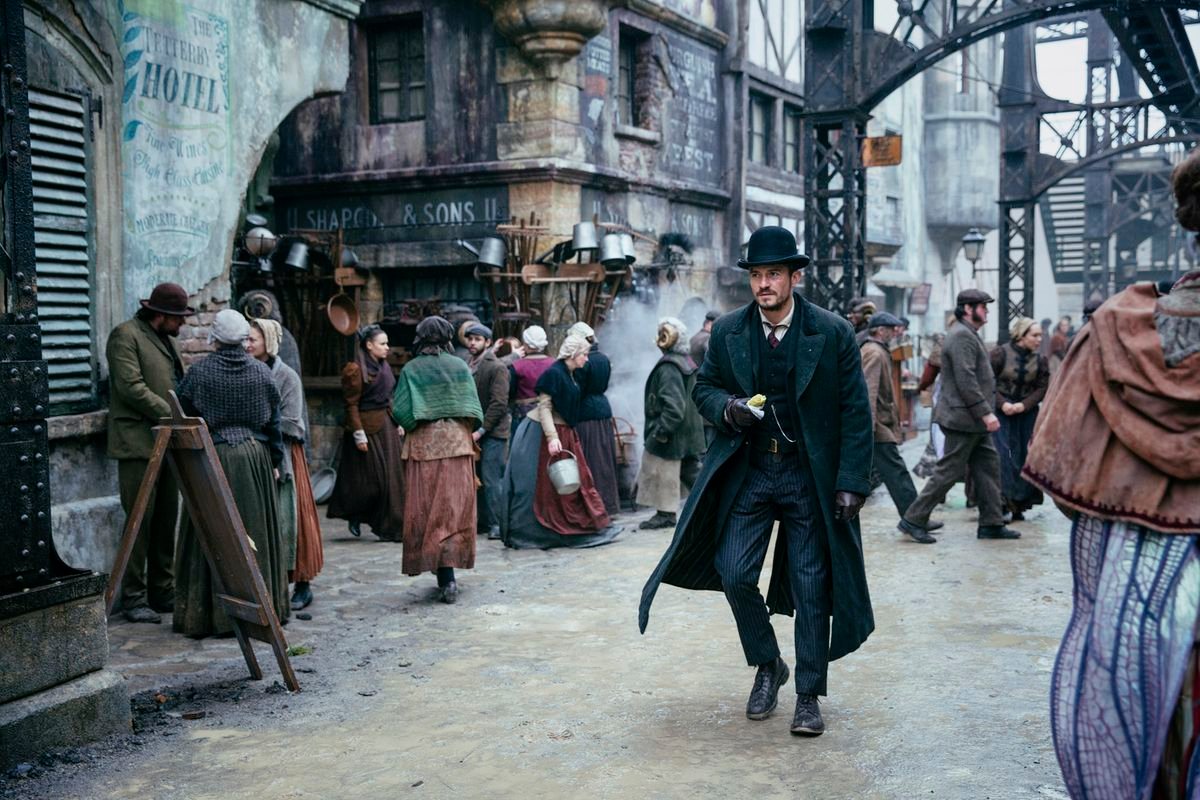
The Wheel of Time is set in a (in)famous pseudo-pre-industrial world of world-ending prophecies, villages with surprisingly competent educational systems, and a suspiciously gendered magical society. On the other hand, Carnival Row takes place in a neo-Victorian cityscape with factories, exploitative practices, refugees, and heartless bureaucracy, which makes you understand why Marx wrote his sensational manifesto.
However, they clash over the same issue that contemporary fantasy consistently trips over: how to portray difference—be it ethnic, cultural, or species-based (do elves and/or orcs have a complete understanding of society)—in a way that feels more like a part of the world rather than an afterthought? To put it another way, are diverse characters viewed as socially significant within the institutions, boundaries, and hierarchies of the setting, or are they merely present, with the narrative tactfully refusing to explain how the society came to be that way?
Let us begin with The Wheel of Time. The Amazon Prime Video adaptation brings Robert Jordan’s famous novel series to the small screen. As mentioned above, it styles itself as high fantasy taking place in a medieval world.
What matters for this article is where the story starts – the small village of Emond’s in the region of the Two Rivers. Multiple characters in the books and the show describe the Two Rivers as isolated, its people as culturally distinct, and as descendants of a long-fallen kingdom (Jordan, 119-136). It is the kind of place where everyone is on a first-name basis. To put it lightly, it is far from a cosmopolitan crossroads and can be seen as a backwater, specifically designed by the author to be as isolated from the wider world as possible, and to serve as a convenient excuse for the main character’s lack of knowledge about it.
So the question is: why does the show depict Emond’s Field as a racially diverse community, even though it is pretty much isolated from the rest of the world?
Before some of you, dear readers, accuse me of bigotry. I must underline that diversity itself is not the problem here. The issue that breaks the immersion for me is the mechanism behind it: what historical or social forces produced this diversity in a region the story repeatedly frames as remote and insular? In a setting that otherwise cares VERY deeply about ancestry, lineage, and local identity, the visual choice raises many questions the show does not appear interested in answering.
To illustrate this more clearly for the people that are not insane poli sci nerds with a fantasy addiction: is the Two Rivers diverse because it has always been so, because the “descendants of a fallen kingdom” were themselves ethnically mixed, or is this diversity the product of factors such as imperial resettlement, refugees, intermarriage over centuries, or some older political crisis that dispersed populations into the region?
If the show offers no internal explanation, the audience is left to improvise. And when audiences are allowed to think for themselves, they tend to stumble into awkward possibilities: either the Two Rivers has a long history of mixing that the story never mentions, or it has the kind of social segregation that a rosy rural prologue absolutely does not need.
My main point here is that depicting Emond’s Field as diverse is not inherently impossible. The issue is that in an isolated, close-knit community, it becomes a worldbuilding choice that requires further explanation—not because such diversity is “unlikely,” but because isolation itself invites the reader to ask how these people got there in the first place. If the setting insists on being insular, then the story has to explain why the insularity did not produce demographic homogeneity, or why it did, and then did not.
And yes, in the real world, there are many examples of ethnically diverse regions whose communities remain relatively isolated from larger cosmopolitan centres. We can point toward regions in the Balkans or Circassia as multicultural environments shaped by long-term coexistence across cultural lines. But that is precisely the point: these places are not “diverse backwaters” by accident.
Their diversity is the result of specific historical developments—migration, conquest, forced resettlement, and survival in difficult terrain. If fiction wants the aesthetic of isolation and the reality of diversity, it needs to smuggle in at least some of those causal mechanisms. Otherwise, the audience is left improvising explanations, and improvisation rarely improves immersion.
Now, let us turn back to Carnival Row. If you, dear readers, have the patience to ignore certain questionable character-development choices, several plotlines that behave like they were assembled during a writers’ room power outage, and the show’s occasional belief that nudity and gore are forms of “good promotion”, it offers something genuinely valuable: a setting whose diversity is explained through the logic of its own history.
Through a series of flashbacks, the audience learns that the city-state of the Burgue, the show’s main setting, was involved in a colonial war against a rival imperial power, a conflict it ultimately lost. The consequences are immediate and legible: displacement, retreat, and a flow of migrants and refugees back toward the metropolitan centre. When this is combined with exploitative labour practices and political scapegoating, the show shows a coherent explanation for why the city is diverse.
Thus, it can be said that Carnival Row does not treat demographic complexity as set. It treats it as the product of politics and then uses those conditions to generate conflict that feels structurally inevitable rather than narratively convenient.
So, can we conclude that this is the silver bullet to actually solving the immersion problem that persists in many contemporary fantasy depictions?
Not by itself, unfortunately…
There is a lot more to consider when writing an immersive depiction of another world, and the backstory alone does not make the plot line immersive (much to the dismay of the fantasy writing community). There are many ways the narrative can undermine the setting’s internal cohesion, but that is a topic for another day.